Air Force Blocks Access to Blogs
By Noah Shachtman
February 27, 2008
The Air Force is tightening restrictions on which blogs its troops can read, cutting off access to just about any independent site with the word "blog" in its web address. It's the latest move in a larger struggle within the military over the value -- and hazards -- of the sites. At least one senior Air Force official calls the squeeze so "utterly stupid, it makes me want to scream."
Until recently, each major command of the Air Force had some control over what sites their troops could visit, the Air Force Times reports. Then the Air Force Network Operations Center, under the service's new "Cyber Command," took over.
AFNOC has imposed bans on all sites with "blog" in their URLs, thus cutting off any sites hosted by Blogspot. Other blogs, and sites in general, are blocked based on content reviews performed at the base, command and AFNOC level ...
The idea isn't to keep airmen in the dark -- they can still access news sources that are "primary, official-use sources," said Maj. Henry Schott, A5 for Air Force Network Operations. "Basically ... if it's a place like The New York Times, an established, reputable media outlet, then it's fairly cut and dry that that's a good source, an authorized source," he said ...
AFNOC blocks sites by using Blue Coat software, which categorizes sites based on their content and allows users to block sub-categories as they choose.
"Often, we block first and then review exceptions," said Tech. Sgt. Christopher DeWitt, a Cyber Command spokesman.
As a result, airmen posting online have cited instances of seemingly innocuous sites -- such as educational databases and some work-related sites -- getting wrapped up in broad proxy filters.
"A couple of years back, I fought this issue concerning the Counterterrorism Blog," one Air Force officer tells Danger Room.
"An AF [Air Force] professional education course website recommended it as a great source for daily worldwide CT [counterterrorism] news. However it had been banned, because it called itself a blog. And as we all know, all blogs are bad!"
He's joking, of course. But blogs and social networking sites have faced all sorts of restrictions on military networks, for all sorts of reasons. MySpace and YouTube are officially banned, for eating up too much bandwidth.
Stringent regulations, read literally, require Army officers to review each and every item one of his soldiers puts online, in case they leak secrets. And in televised commercials, screensavers and fliers, troops are told that blogging is a major security risk -- even though official sites have proven to leak many, many more secrets. Now there's the Air Force's argument, that blogs aren't legitimate media outlets -- and therefore, shouldn't be read at work.
But this view isn't universally held in the military. Many believe blogs to be a valuable source of information -- and a way for ordinary troops to shape opinions, at home and abroad. Gen. David Petraeus, who heads the U.S. effort in Iraq, has commended military bloggers. Lt. Gen. William B. Caldwell IV, who replaced Petraeus as the head of the Combined Arms Center and Fort Leavenworth, recently wrote (in a blog post, no less) that soldiers should be encouraged to "get onto blogs and [s]end their YouTube videos to their friends and family."
Within the Air Force, there's also a strong contingent that wants to see open access to the sites -- and is mortified by the AFNOC's restrictions. "When I hear stuff this utterly stupid, it makes me want to scream.... Piles of torn out hair are accumulating around my desk as we speak," one senior Air Force official writes in an e-mail. "I'm certain that by blocking blogs for official use, our airmen will never, ever be able to read them on their own home computers, so we have indeed saved them from a contaminating influence. Sorry, didn't mean to drip sarcasm on your rug."
One of the blogs banned is In From the Cold, which examines military, intelligence and political affairs from a largely right-of-center perspective. It's written by "Nathan Hale," the pseudonym for a former journalist and Air Force intelligence officer, who spent more than two decades in the service. He tells Danger Room, "If knowledge and information are power -- and no one disputes that -- then why not trust your people and empower them to explore all sides of issues affecting the service, air power and national security?"
Obviously, DoD [Department of Defense] can decide what internet content should be filtered -- they spent billions on the IT architecture and billions more to maintain it. But if it's a matter of "ensuring worker productivity" and deterring "wasteful surfing of the internet," does it really make sense to block relatively small blogs (that just happen to focus on military and security issues), while allowing everyone to access ESPN or FoxSports?
Wonder how much work time will be lost on filling out "March Madness" brackets, versus reading a military or intelligence blog? In short, there doesn't seem to be any consistency in the current DoD policy. And that's no surprise. A few months ago, a senior Pentagon P.A. [public affairs] official told me that his service had no plans to engage the blogosphere, because their studies showed that "people don't rely on blogs for news and information." And he said it with a straight face.
The Air Force recently launched an $81 million marketing campaign to convince lawmakers and average citizens of its relevance in today's fights. By making it harder for troops to blog, an Air Force officer says, the service had undermined "some of their most credible advocates."
"The Air Force isn't getting the planes that they want because they are incapable of communicating their usefulness and applicability in this new war. Because Air Force officers talk more like corporate bureaucrats than cocky war fighters, no one is inspired or convinced of their pressing (and quite legitimate) need to modernize the force," he adds. "Air Force bloggers spoke the lingo of someone heavily invested in the fight, because they operate outside the survival-minded careerist world of public affairs, with many of them penning blog posts from theater."
Perhaps, says retired Air Force Col. Tom Ehrhard, who's now a Senior Fellow at the Center for Strategic and Budgetary Assessments. But there are legitimate security reasons why blogs need to be restricted. Adversaries may be using blogs to take advantage of airmen, he notes.
It is increasingly clear that active exploitation could take advantage of airmen and civilians who want to inform and correct the often outrageous, false assertions on these blogs. In doing so, it is easy for well-meaning insiders to violate operational security (OPSEC) tenets, either directly or tangentially. We are in a different world today when it comes to sensitive military information, and foreign intelligence operatives surely understand this and will exploit it.
As a former member of Strategic Air Command, where OPSEC was (rightly) an obsession, this has been obvious to me for some time in reading aerospace-oriented blogs. This policy strikes me as a timely reminder to Air Force professionals that they should be on guard when blogging, because someone is watching.
Source:
http://blog.wired.com/defense/2008/02/air-force-banni.html
________________
Friday, February 29, 2008
Thursday, February 28, 2008
Public Broadcasting Activists Refute McCain Campaign "Facts" on FCC Letters
By Avni Patel
ABC News
February 26, 2008
A public broadcasting activist is accusing Sen. John McCain's presidential campaign of lying in its statements rebutting last week's New York Times story about McCain's connections to Washington lobbyist Vicki Iseman.
After the story broke, the McCain campaign distributed a lengthy document stating that the senator's commerce committee staff "met with public broadcasting activists from the Pittsburgh area" who opposed a controversial license swap involving Iseman's client, Paxson Communications, before it sent two letters to the Federal Communication Commission urging the commissioners to vote on the issue.
"It never happened," said Jerold Starr, who led the grassroots opposition to the deal as the co-chairman of the Save Pittsburgh Public Television Campaign. "Moreover, we had no idea that McCain had any interest in our local matter."
Starr's co-chair on the campaign, Linda Wambaugh, said that she and Starr handled all the lobbying for campaign.
"We were it. Anything would have come through us," said Wambaugh. "There was absolutely no contact whatsoever - no meetings, no phone calls, no correspondence."
The McCain response document also claimed that both Paxson's lobbyists and the public broadcasting activists "expressed to staff members their frustration that the proceeding had been before the FCC for over two years. Both parties asked the staff to contact the FCC regarding the proceeding."
"That's a bold-faced lie," said Starr, who wrote about his experience leading the campaign in his 2000 book "Air Wars." "The longer it took, the better our chances were. It meant that the FCC was paying serious attention to our complaint."
The McCain campaign questioned how Starr would be able to remember every meeting from nine years ago, though it says its own statement was based on the recollections of the Commerce Committee staff at the time.
The McCain letters, sent on Nov. 17 and Dec. 10 of 1999, came weeks before Paxson's deal to swap licenses with religious broadcaster Cornerstone Communications was set to expire.
Angela Campbell, a Washington lawyer who represented the Pittsburgh activists, says the timing of the letters was "clearly in Paxson's interest," although the letters included a disclaimer stating that the senator took no position on the vote.
Questions have been raised about other statements contained in the McCain response to the Times story over the past few days. Newsweek.com reported on Friday that a 2002 deposition indicated that McCain recalled discussing the Pittsburgh deal with Lowell "Bud" Paxson prior to sending the letters - an apparent contradiction of the campaign's statement that the senator never personally discussed the matter with Paxson or his lobbyists.
Paxson told the Washington Post on Saturday that he recalled discussing the matter with McCain in the senator's office weeks before the letters were sent. Another Paxson lobbyist, Dean Goodman, later told the Associated Press that he doubted Paxson's recollection.
Source:
http://blogs.abcnews.com/theblotter/2008/02/public-broadcas.html
_________________
Sunday, February 24, 2008
Turkey enters World War III
US plans to redraw the borders of the Middle East becoming realized
By Chyco
Feb. 24, 2008
Now that Turkey has entered Iraq after “two months of air strikes”, with the death toll in the last three days drastically rising, we can only assume that the US invasion of Iraq has now engulfed Turkey.
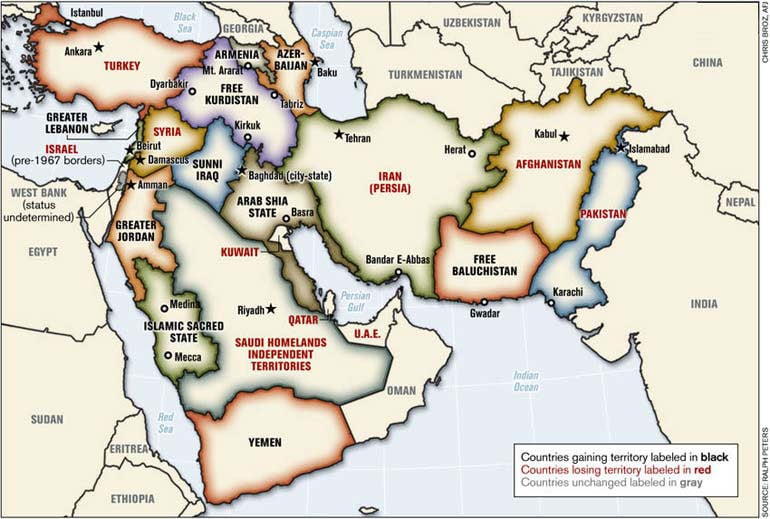
If the Iraq war escalates, engulfing the region, then we are closer to creating the “New Middle East”, the plans for which were revealed in 2006 by retired Lieutenant-Colonel Ralph Peters. The map, with the redrawn borders of the Middle East, indicates that Turkey would lose a large portion of its territory while Iraq would be split into three autonomous regions. This map also shows plans to partition Pakistan and reduce Iran’s territory, along with numerous other imperial agendas.
New Middle East click to enlarge source
Unfortunately for the world however, such an endeavor as redrawing the borders of so many countries would be nothing less then World War III. A conservative estimate of how many people would die in this global war can be obtained by assuming that the same percentage of people that died in World War II would also die in World War III.
In the 1940’s the world population was approximately 2.3 billion. World War II resulted in 72 million deaths (42 million of which were civilian casualties). This means that approximately 3.1% of the worlds population was killed.
At present, the world population is approximately 6.6 billion. If we assume that the same percentage of people will die during this world war then the last, it would mean that over 200 million people will be dead in the next few years. This is a conservative estimate since nuclear weapons were introduced at the end of World War II, while they are being proposed at the beginning of World War III. The number of wounded will be well over 1 billion if we assume a kill to wounded ratio of 5 to 1.
Isn’t it about time that we told our leaders that war is no longer an option and that we will not kill or die for them? After all, it is not their children who fight and die in these wars.
Source:
http://www.chycho.com/?q=turkey_ww3
_____________
False Flag Prospects for 2008
Top Three US Target Cities
By Captain Eric H. May
Military Correspondent
Feb 23, 2008
Forewarning
The easiest way to carry out a false flag attack is by setting up a military exercise that simulates the very attack you want to carry out. As I'll detail below, this is exactly how government perpetrators in the US and UK handled the 9/11 and 7/7 "terror" attacks, which were in reality government attacks blamed on "terrorists."
Although ill health keeps me from working as hard in the area of false flag analysis as I used to, the urging of independent editors and brother intelligence officers has prompted me to write this essay. I'll keep it short for readers with limited time, but I will include invaluable links for those who want to delve deeper and understand better.
My aim, as a former military intelligence officer who spent five years with the U.S. Army 75th Division conducting military war games, is to convince the American people that the "next 9/11" -- constantly promised by officials and the media -- is likely to be carried out under the guise of future military exercises. If the American people are aware of pending exercises and the danger they represent, then the exercises cannot "go live" and effect the very terror events that they are supposed to be rehearsing against.
Military Exercises
The 9/11, 2001 attacks in the United States and the 7/7, 2005 attacks in the United Kingdom both have smoking guns proving that the mass murderers were not foreign terrorists but domestic tyrants. Each country's government was conducting military exercises that simulated the exact events that were to occur.
The US 9/11 Commission stumbled across strong evidence of treason by Dick Cheney when it interviewed Secretary of Transportation Norman Mineta, who was present in Cheney's famous command bunker as Flight 77 sped toward Washington, DC. Cheney was at the center of national military exercises simulating terrorist hijackings of US aircraft -- at the very time that those hijackings were occurring in real life.
On May 23, 2003, Secretary Mineta testified:
"During the time that the airplane was coming in to the Pentagon, there was a young man who would come in and say to the Vice President, "The plane is 50 miles out." "The plane is 30 miles out." And when it got down to "the plane is 10 miles out," the young man also said to the Vice President, "Do the orders still stand?" And the Vice President turned and whipped his neck around and said, "Of course the orders still stand. Have you heard anything to the contrary?"
9/11 Commission co-chairman Lee Hamilton failed to follow up on the bombshell revelation, and quickly switched the topic. Thanks to YouTube, Mineta's astounding revelation and Hamilton's amazing reaction are both viewable on a three minute clip: http://www.youtube.com/watch?v=bDfdOwt2v3Y
In the case of the 7/7 London railway bombings, there is same-day evidence in a BBC interview with former Scotland Yard anti-terrorism agent, Peter Power, who was a contract employee working in government exercises:
POWER: "At half past nine this morning we were actually running an exercise for a company of over a thousand people in London based on simultaneous bombs going off precisely at the railway stations where it happened this morning, so I still have the hairs on the back of my neck standing up right now."
BBC HOST: "To get this quite straight, you were running an exercise to see how you would cope with this and it happened while you were running the exercise?"
POWER: "Precisely."
For a one minute excerpt containing the statements above, refer to
http://www.youtube.com/watch?v=JKvkhe3rqtc
Mainstream Media
It goes without saying that serious media inquiry would quickly ferret out the facts demonstrating high treason in the cases of 9/11 and 7/7. It also goes without saying, unfortunately, that the traitors behind the two false flag attacks understood this very well, and would not have done what they did without a green light from a collaborative media.
Three World Trade Center buildings collapsed in New York City on September 11, 2001: WTC 1 and WTC 2 (the Twin Towers) in the morning, and WTC 7 (the Salomon Building) at 5:20 p.m. EST. Given that all three buildings were said to be unexpected collapses by all official sources, there is no good reason -- except for complicity -- to explain how it is that the BBC reported the collapse of WTC 7 twenty minutes before it happened:
http://www.youtube.com/watch?v=C7SwOT29gbc&feature=related
Fox news damned itself by announcing that WTC 7 had collapsed -- even as it showed a live shot of downtown New York with WTC 7 still standing. A few seconds later the building collapsed, understandably confusing the newscasters: http://www.youtube.com/watch?v=GwUJ9MhzgKI
The owner of all three buildings was Larry Silverstein, who had recently doubled the insurance value of the Twin Towers. Amazingly, "Lucky Larry," later stated in a PBS interview that he and the New York Fire Department agreed to a controlled demolition of WTC 7. Since skyscrapers are not wired for demolition -- unless someone intends to demolish them -- Silverstein's statement is an admission that 9/11 was an inside job:
http://www.youtube.com/watch?v=7WYdAJQV100
"The Noble Lie"
I believe that on the strength of the five YouTube links above an objective investigation would have more than enough evidence to warrant impeachment of Bush and Cheney on a charge of high treason, and to summon a grand jury that would indict many others on charges of high treason against Larry Silverstein and other apparent 9/11 collaborators. I believe that the American people, if presented with a single news story containing the five YouTube links above, would demand that the case of high treason be carried to its logical conclusion.
Congress, though, won't impeach the president. The mainstream media, for which I used to write, will not investigate and report the story. The military that was used as a tool to mass murder American citizens will not take action against traitors in uniform who knew exactly what they were doing on 9/11, or the many more uniformed dupes who thought they were conducting military exercises until the events of 9/11 occurred. To this day there have been no adverse actions -- which would require investigation and evaluation -- against any military person involved in what even official apologists call the greatest defense failure in American history. All of this shows that the fix is in, and that we are in a fix.
The high officials, media executives and military officers who are bound by law and ethics to serve the American people have become a textbook example of a grand conspiracy. To look at it from their point of view, they are historic actors who are beyond good and evil, who must stimulate the American people to a necessary geostrategic adventure by any means necessary.
To them, the official account of the 9/11 "terror" attacks is what Plato once described as the "noble lie," a necessary falsehood told to a childlike public in order to direct it maturely. The simple fact is that 9/11 has justified an attempt to seize and control the ultimate geostrategic resource: oil. He who controls Middle East oil controls the world.
Top Three US Target Cities
Last year I published "Next 9/11, Summer 2007?" in response to the same kind of requests that have led me to publish this essay as a 2008 update. My 2007 three most likely cities for the next 9/11 were Houston, Chicago, and Portland. This year the same three cities are still most endangered, in light of the fact that the US military has designated Texas, Indiana and Oregon as three of its four target states in the 2008 version of its Noble Resolve military exercises.
Granted, Chicago is in Illinois, not Indiana, but Indiana is quite close, and has been used to stage forces for terror exercises conducted in Chicago in recent years.
It may come as a surprise to people not acquainted with military preparations that the same cities remain on the list even though analysts like me have publicized them widely. There are considerable difficulties in setting up the political, police, military and media players necessary to support a false flag attack. While many in the 911 truth movement believes that national military forces can simply hit any city at any time, it's not so easy -- thank God. Fortunately, this means that those of us who study false flag prospects and focus on most likely targets; regrettably, this means that target cities can't breathe easy just because they have detected, exposed and preempted a single false flag attempt.
Here is a brief target analysis of the top three cities:
Primary Target: Houston. Over the past four years military and police veterans like me have been alerting the public to government exercises aiming at the nuclear destruction of Houston petro-suburbs. Five times in those four years we were able to predict to within a day major petrochemical explosions in those petro-suburbs. The odds against this kind of accuracy are astronomical. As the center of Big Oil and the Bush Family, Houston remains the most endangered city in America. Any patriotic group, like mine, trying to alert its home city to the
dangers of a false flag attack should read my recent article, "The 1/31 Nuke: Proof for Ron Paul" about the successful interdiction of a 2006 attempt against Texas City: http://www.thepriceofliberty.org/08/01/28/may.htm
Secondary Target: Chicago. While Houston is the most endangered city, the most endangered building -- the best candidate to be the next World Trade Center -- is the Sears Tower. Official sources have pronounced it just that ever since the original 9/11 attack, when they said it was on the Al Qaeda hit list. Larry Silverstein, who bought the Twin Towers two months before 9/11, led a group that purchased the Sears Tower on 3/11, 2004, the day of the Madrid bombings.
Federal officials have been pointing to Chicago and its Sears Tower as Al Qaeda targets since the original 9/11 attacks, and have repeated the threat ever since. In May 2006,, the government scheduled secret 9/11-type exercises in Chicago, while Chicago Mayor Daley was docked conveniently away in Israel for his first visit there. I sent a widely read communiqué to Illinois Governor Blagojevich as part of a successful Internet attempt to shut down the pending
false flag attack: http://tekgnosis.typepad.com/tekgnosis/2006/05/ghost_troop_com.html
Tertiary Target: Portland. Portland, called "Little Beirut" by Bush cronies because of its enmity to Bush 41 and Bush 43, only made my top three list last summer, when it was designated as a target for a nuclear attack by successive exercises Noble Resolve and TOPOFF.
The language in an official press release stated the case plainly enough: "Noble Resolve will coordinate with officials in Oregon to model a nuclear attack on Portland." In the course of researching Portland for a series of articles I wrote about the city and its exercises.
I discovered that Stanford and Harvard had prepared a detailed nuclear fallout map for it, that national military commanders and state National Guard commanders were telling different stories about what the exercises were trying to accomplish, and that Portland's The Oregonian newspaper was doing everything it could to avoid investigating the frightening anomalies.
I wasn't at all surprised that the last day of the exercises found the Homeland Security director Michael Chertoff in downtown Portland, which was largely closed down by an "unexpected" bomb threat. For another professional perspective on how great the danger was -- and may be again -- I refer the reader to the analysis of my colleague, Major William B. Fox (USMC):
http://www.lonestaricon.com/absolutenm/anmviewer.asp?a=2006&z=186
Postscript
"Good morning. At this moment, somewhere in the world, terrorists are planning new attacks on our country. Their goal is to bring destruction to our shores that will make September the 11th pale by comparison." -- George W. Bush, Feb. 13, 2008
I can't think of a more important question than the one of where the next 9/11 will be attempted. Common sense dictates to all of us who understand the truth about 9/11 that its perpetrators must strike again. Indeed, every directive, act and decision of our post-9/11 unitary executive, cowards Congress and Judas judiciary has increased the power of the federal government to wage the Global War and impose the Homeland State.
Why on earth would those already guilty of high treason, mass murder and war crimes fail to follow up on their earlier efforts? They understand quite well that the Global War is going badly and the Homeland State is becoming onerous, and that only a reapplication of false flag terror will force the American people to proceed with our post-9/11 national insanity.
Still, for every one person who republishes or constructively comments on this essay, there will be another who employs division, abuse and ridicule against me or anyone else who asserts the common sense point that false flaggers will continue to false flag, just as murderers will continue to murder and robbers will continue to rob. It's Newtonian in its simplicity: things continue to
drift the way they are drifting until they are stopped.
We can only stop the deadly drift of America by understanding 9/11 and anticipating the next 9/11. Many of the vociferous voices impeding our understanding and anticipation are performing a vital service for treason. The federal government once used counterintelligence programs (COINTELPRO) against the Vietnam era antiwar and civil rights movement, and common sense would suggest that they are using it again in the post-9/11 era, this time against the antiwar and 911 truth movement. The most dangerous voices of all our those from false friends who have infiltrated us to confuse us until the traitors who carried out 9/11 can repeat their performance.
Captain May is a former Army military intelligence and public affairs officer, as well as a former NBC editorial writer. His political and military analyses have appeared in The Wall Street Journal, the Houston Chronicle and Military Intelligence Magazine. For more information, or his interview schedule, refer to his homesite:
http://www.spiritone.com/~pazuu/pow-mia/Ghost_Troop_Captain_Eric_H_May.htm
Source:
http://groups.yahoo.com/group/RUMORMILLNEWS/message/38768
___________________________
Saturday, February 23, 2008
John McCain and the Clinton Rules
by Jamison Foser
Media Matters
In the wake of this week's controversy surrounding John McCain's dealings with lobbyists, and his honesty about those dealings, it is impossible to avoid thinking about how differently the media would have handled the news had it been about Bill Clinton or Al Gore rather than John McCain.
Three consistent rules of media coverage of purported scandals involving progressives come immediately to mind: If any part of an alleged scandal turns out to be true, the media behaves as though the entire story is true.
Take, for example, Gennifer Flowers. In 1992, Flowers claimed that she and Clinton had a 12-year affair. In 1998, during his deposition in the Paula Jones case, Clinton acknowledged having had "sexual relations" with Flowers, one time. Under the definition of "sexual relations" at use for that deposition (at the insistence of Jones' attorneys, not Clinton) Clinton's acknowledgment didn't mean much: It could have meant that he and Flowers slept together, or it could have meant that he briefly placed his hand on her thigh in a bar. Clinton didn't explain what had happened, and -- significantly, one would assume -- the Jones attorneys didn't ask him to.
For the past 10 years, the news media have portrayed Clinton as having acknowledged that Flowers' story was true. He did nothing of the kind -- and Flowers is just about the least credible accuser you could imagine, having lied about the place her supposed affair with Clinton began, about her education, about her career as an entertainer, about having been kidnapped, and about having a twin sister.
Yet because Clinton acknowledged there to be a sliver of truth to Flowers' wild claims, the news media pretended her entire story was true.
Similarly, despite the fact that example after example of Al Gore purportedly lying or exaggerating turned out to have been made up (or, perversely, exaggerated) by the news media as part of what Bob Somerby has rightly called their "War Against Gore," the media continued to pretend that the entire line of criticism of Gore had merit simply because they could point to one example that supported their case. Gore didn't tour Texas with James Lee Witt -- so the whole years-long smear campaign against him must be true!
Media parse every statement by progressives in response to controversy, looking for something to ridicule -- whether the ridicule is fair or not.
Bill Clinton's statement about "what the meaning of the word 'is' is," Al Gore's reference to "no controlling legal authority" in response to questions about his fundraising, Hillary Clinton's explanation that she has always been a Yankees fan, John Kerry's comments about voting for Iraq funding before voting against it -- all have been the subject of literally years of media ridicule.
Never mind that Bill Clinton was making the correct point that the tense of the question he was asked, and of his answer, was directly relevant to the issue of whether he was lying about something that happened in the past.
Never mind that Gore's point, which was basically that he hadn't broken any laws, was right (he was never charged with, never mind convicted of, any crime).
Never mind that Hillary Clinton really has always been a Yankees fan, as the comments of her childhood friends -- not to mention old photographs of her in a Yankees hat -- demonstrate. Never mind that Kerry was talking about two different versions of the bill, not about flip-flopping on one version -- and never mind that President Bush had said he would veto one version, then signed the other.
To this day, the media mock them for these statements. And they don't just mock: These comments are depicted as evidence of character flaws.
Allegations that turn out to be unproven, or even false, are used by the media as evidence in support of future allegations.
Again, Flowers is a perfect example. Not long after she first sold her story to a supermarket tabloid, Flowers had been shown to be a liar. And she thoroughly failed to support her allegations against Clinton -- the audiotapes she produced were reportedly spliced, and, as Joe Conason and Gene Lyons have noted, "Flowers never produced a single paragraph, valentine, or birthday card as evidence of her twelve-year affair with Clinton; no witness ever came forward who had seen them together. Indeed, she would eventually write an entire book, Passion and Betrayal, without stating a specific time and place where she and her famous lover were together."
Perversely, Flowers' unproven (and in large part debunked) allegations against Clinton were subsequently invoked by the news media as proof that other allegations of infidelity by Clinton were true.
Such absurd standards played a role in the spread of the Gore-as-liar narrative. Examples of Gore as a liar or exaggerator were trotted out by the media, shown to be false, then later recycled as evidence of a pattern when some future bogus example was invented. Al Gore didn't actually take credit for having discovered Love Canal -- it simply didn't happen; it was made up by reporters at The New York Times and The Washington Post.
It was conclusively demonstrated to be a made-up story, and the newspapers (eventually) ran corrections. Then what happened? Love Canal, alongside the equally bogus allegation that Gore had claimed to have invented the Internet, was regularly invoked by reporters to bolster subsequent depictions of Gore as a liar and exaggerator.
The media's apparent belief that it is acceptable to say any damn thing they want, true or false, as long as they say it about the Clintons, has become known as the "Clinton Rules of Journalism."
Those rules, however, apply to progressives broadly, not just the Clintons. They have applied to Al Gore, as indicated above, and to John Edwards (witness the nonsense about his haircut). And there are signs Barack Obama may soon have to deal with these rules, if it hasn't started already. The New York Times' (truly bizarre) recent attempt to portray Obama as having used drugs as a teenager less than he suggested in his autobiography is one such example.
As The New Yorker's Hendrik Hertzberg observed:
The news here is -- what, exactly? That Obama, who now appears grounded, motivated, and poised, formerly appeared grounded, motivated, and poised? That his inner uncertainties, such as they were, were more apparent to himself than to others? That he was marginally less of a pothead than he has made himself out to be? ... For a candidate to stand accused of exaggerating his youthful drug use is something new indeed.
The Clinton Rules are, on their own, a clear indictment of modern political journalism. It should go without saying that making up quotes in order to depict a politician as a liar is horrible journalism. It should go without saying that repeating long-ago debunked claims is, too.
But as bad as these things are, they are made even worse by the contrasting treatment that leading Republicans have gotten from the media in recent years.
Not only have the three rules discussed above not typically been applied to the likes of George W. Bush and John McCain, the media also have often taken the opposite approach.
While Democratic "scandals" have been treated as true if any individual element has turned out to be accurate, allegations against Republicans have been deemed false if any individual element turned out to be wrong -- or even questionable.
The clearest example of this is the 2004 controversy around Bush's National Guard service, or lack thereof.
The national media spent years ignoring documentary evidence that Bush didn't fulfill the requirements of his National Guard commitment, and attacking those who raised the issue. In 2004, for example, ABC's Peter Jennings called Michael Moore's assertion that Bush was a "deserter" a "reckless charge not supported by the facts" and suggested it was an example of poor "ethical behavior" for Wesley Clark not to have contradicted Moore. In fact, there was ample evidence that Bush had not bothered to show up for required Guard duty -- evidence Jennings and ABC had been carefully ignoring for years.
Later that year, when CBS News aired a report about Bush's Guard service, conservatives seized on documents used in that report that they claimed were fake. The media immediately acted as though the entire question about whether Bush fulfilled his commitment to the National Guard came down to whether or not the CBS documents were real, ignoring voluminous other evidence.
When a consensus emerged that they were not, the media treated this as vindication for Bush and his campaign -- despite the fact that, with or without the CBS documents, there is overwhelming evidence that Bush skipped out on his Guard duty. (It should be noted that though there emerged a consensus that the documents were not real, this was not proven, and former CBS anchor Dan Rather is suing the network over its handling of the matter.)
Likewise, when news broke this week that John McCain may have done legislative favors for a lobbyist with whom he may have had an affair, countless journalists quickly declared that the alleged affair was all that mattered. If there was no affair, they asserted, McCain would be vindicated. Never mind the indications that McCain may have done favors for lobbyists -- exactly the type of image-incongruous behavior the media pounce on when the subject is a Democrat.
How many times were we sanctimoniously told by journalists that the reason the Edwards haircut got so much media attention was that it supposedly conflicted with his image as an advocate for the poor and middle class? Well, no politician in recent memory has had an image as well-developed as McCain, who (thanks largely to the news media that adore him) is seen as a reformer, a man of principle, a tireless warrior against the influence of special interests.
But this week brought explosive allegations that, in contrast to this image, McCain (who was, remember, one of the Keating Five) may have been doing favors for lobbyists. It also brought a reminder that he has essentially turned his presidential campaign over to some of the nation's most powerful lobbyists. Yet, rather than seizing on this tension between McCain's carefully cultivated image and his actions, many journalists swiftly moved to declare it a non-story: All that mattered was the alleged affair, and if that didn't happen, McCain must be innocent of everything, the victim of a "smear."
In contrast to their treatment of Democrats, in which they declare a "scandal" true if any element of it is true, the media have moved to declare the entire McCain story a "smear" if any element of it is false.
And rather than examine whether McCain reacted to the stories with false claims, contradictions, or absurdities, as they have done to countless Democrats in the past, much of the media simply noted his denials and behaved as though the story is all about The New York Times' behavior in breaking it.
Just as they had with the Bush National Guard story, other media quickly made the Times the story, rather than McCain's actions and statements. (One notable exception: a Newsweek article by Michael Isikoff that begins: "A sworn deposition that Sen. John McCain gave in a lawsuit more than five years ago appears to contradict one part of a sweeping denial that his campaign issued this week to rebut a New York Times story about his ties to a Washington lobbyist.")
Yesterday, John McCain's presidential campaign sent out a fundraising email (from lobbyist/McCain campaign manager Rick Davis) that claimed, "Objective observers are viewing this ... as a sleazy smear attack from a liberal newspaper against the conservative Republican frontrunner."
The email quoted four such "objective observers," including right-wing Fox News host Sean Hannity, former Republican Congressman Joe Scarborough, and "Washington attorney Bob Bennett, who was the Democrat counsel during the Keating investigation."
The description of Hannity and Scarborough as "objective observers" is funny enough, but Bob Bennett is John McCain's personal attorney in this matter. He is the exact opposite of an "objective observer" -- he is a paid advocate on McCain's behalf. When he defends McCain, he isn't doing so as an "objective observer," he is doing so in exchange for hundreds of dollars an hour.
McCain's campaign manager's portrayal of McCain's personal lawyer as an "objective observer" defending McCain isn't merely a breathtaking display of chutzpah, though it is certainly that. It is also precisely the kind of thing that, had it been done in defense of Bill Clinton or Al Gore, would have led to a cascade of ridicule from the news media. We would constantly hear about how they were hurting themselves with such transparently dishonest defense, which not only calls their character into question, it suggests that the underlying allegations must be true.
Tucker Carlson would have a field day mocking the defense, and he wouldn't be alone. And, for once, he wouldn't be wrong.
Yet, when this transparently dishonest defense is made on John McCain's behalf, the media ignore it.
The hinted-at-but-not-proven (and thus, perhaps not real) affair between McCain and the lobbyist is, in many ways, the least important and least interesting aspect of this week's revelations. As Media Matters' Eric Alterman noted yesterday, "It's none of our business and does not belong on the front page of The New York Times, regardless of timing. What's more, the sex gets in the way of what is really important about McCain's behavior."
But the media's reaction to this element of the story is very interesting -- particularly in contrast to their treatment of allegations of affairs by Democrats. McCain left his first wife for his current wife -- a fact that was notably absent from yesterday's cable coverage of the McCain controversy. Whenever some new allegation of an affair by Clinton popped up, the media were quick to invoke previous (unproven and in many ways provably false) claims, like those of Gennifer Flowers, as evidence of a pattern that made the new allegations likely to be true. Yet here we have the media ignoring McCain's history with women, even as they discuss the possibility of an affair between McCain and a lobbyist.
Then there's the reaction to the New York Times article. All day yesterday, a firestorm raged in the media over the Times article, as journalists from other news organizations denounced the paper for suggesting, based on unnamed sources, that McCain had an affair. It was denounced as a smear, and reckless journalism.
Some of the same people who were challenging the Times' reliance on unnamed sources, and its printing of what amounts to rumors of an affair, praised the Times for doing exactly the same thing nearly two years ago.
Well, not quite the same thing: Back then, the victim of the Times' crude innuendo was Bill Clinton, not John McCain.
When The New York Times ran a 2,000-word article about the state of the Clintons' marriage in May of 2006, the paper passed on gossip about Bill Clinton and a Canadian politician named Belinda Stronach. According to the Times, "Several prominent New York Democrats, in interviews, volunteered that they became concerned last year over a tabloid photograph" of Clinton and Stronach.
Chris Matthews, among others, loved -- loved -- the article. He discussed it again and again and again on Hardball. He -- approvingly -- described it as a warning from The New York Times to Clinton that "he better watch it" and "behave himself." Interviewing Clinton aide Ann Lewis, Matthews added, "I think it'd be great for the country if ... we were not once again distracted by what you call private life. And I think the way to avoid getting distracted is to have nothing there to distract us. ... I want to have some assurances from people that I trust and like to spread the word that he better watch it."
In short, Matthews did not criticize the Times article; he endorsed it. He didn't complain about it being based on unnamed sources, or about the paper trafficking in gossip it couldn't prove true.
Now, how did Matthews react to the Times article about McCain, a man Matthews has said "deserves" to be president? Did he repeatedly ask if McCain would "behave himself" during the campaign? Did he approvingly note that the Times had sent a warning that McCain "better watch it"? Of course not.
Instead, Matthews turned on the Times for the same type of reporting it had employed in the Clinton article. Again and again he used his perch at MSNBC to rail against the Times not only for using unnamed sources in the McCain article, but for failing to explain why it was granting the sources anonymity, which, as Matthews pointed out, is inconsistent with the Times' guidelines.
But Matthews expressed no such concern about the 2006 article about Clinton. Here's the Times' passage about Stronach again -- a passage the Times' public editor at the time said should not have appeared in the paper: Because of Mr. Clinton's behavior in the White House, tabloid gossip sticks to him like iron filings to a magnet. Several prominent New York Democrats, in interviews, volunteered that they became concerned last year over a tabloid photograph showing Mr. Clinton leaving B.L.T. Steak in Midtown Manhattan late one night after dining with a group that included Belinda Stronach, a Canadian politician. The two were among roughly a dozen people at a dinner, but it still was enough to fuel coverage in the gossip pages.
Why had the Times granted anonymity to the "New York Democrats"? The Times didn't say -- and Chris Matthews didn't give a damn; he was just thrilled that the paper had issued its "warning." Of course, back then, the targets of the Times' article were the Clintons, and Chris Matthews very much does not like the Clintons. Now the subject of a Times article relying on unnamed sources is McCain, who Matthews thinks "deserves" to be president. And so Matthews now righteously denounces the same sourcing techniques that he didn't mind at all when the subject was Clinton.
And Matthews has repeatedly railed against the Times for running the McCain story on the front page, above the fold -- right where the Times' article about the Clintons' marriage ran.
Not that Matthews has cornered the market on blatant double standards. His MSNBC colleague Tucker Carlson kept insisting that the Times' reference to a possible affair by McCain was inappropriate because, according to Carlson, the media collectively agreed not to focus on such things post-Monica Lewinksy. To his credit, this is not the first time Carlson has been outraged by discussion of a candidate's marriage: He frequently opposes such discussion -- when Republicans are the subjects.
The point here isn't that the Times article about McCain was flawless. It wasn't. The paper could have run, as many have noted, a much stronger article that focused on McCain's actions on behalf of lobbyists, without including unnamed sources asserting that unnamed aides believed McCain to have had an affair. But I don't remember Chris Matthews or Tucker Carlson or the countless other journalists who have denounced the Times over the past two days leveling a similar complaint about unnamed sources talking about Clinton and Stronach. To the contrary; they embraced that article.
Regardless of the merits of the Times article, particularly its treatment of the affair question, it is important to recognize the blatant double standards media employ to hype stories damaging to Democrats and downplay and dismiss those damaging to Republicans.
The Clinton Rules make for lousy journalism, as we've seen over the past two decades. But the media's rush to dismiss serious questions about prominent Republicans is no better than their repeated peddling of bogus stories about Democrats.
Source:
http://mediamatters.org/items/200802220015?f=h_latest
_________________
Friday, February 22, 2008
KEY McCAIN ALLY INDICTED
Arizona Republican Rick Renzi Charged With Wire Fraud, Money Laundering
The Nation
Feb. 22, 2008
Another GOP congressman has been indicted.
This time it's Rick Renzi, indicted by a federal grand jury in Arizona today on charges of wire fraud, money laundering and extortion as part of a multimillion dollar land deal that allegedly improperly benefited Renzi and his business partners.
Renzi, a three-time representative from Arizona's First Congressional District who announced his retirement in August, also happens to be a close ally of Senator John McCain. Renzi is a co-chair of McCain's campaign in Arizona. The Arizona Republic describes the two men as "close." In June 2006, McCain sent out a fundraising letter on Renzi's behalf.
"Already his liberal opponents have started advertising on television against him and the Washington liberals have recruited a multi-millionaire from Ohio to challenge him in November," McCain wrote in the e-mail. "Rick's opponent, Ellen Simon, is the former president of the ACLU and has pledged to spend millions of her own dollars to defeat Rick. We simply cannot let this happen," McCain said.
As far back as September 2005, Citizens for Ethics and Responsibility in Washington listed Renzi as one of the "most corrupt" members of Congress.
News of Renzi's land scheme had been percolating for a long time before it finally became public in October 2006. "Many people had information on Rick Renzi and his corrupt practices in 2006, which is one reason I ran for Congress," says Ellen Simon, a civil rights lawyer who was falsely accused by McCain and others of being president of the ACLU. "At the same time this information was known, John McCain was actively supporting Renzi in the race."
Renzi narrowly defeated Simon in the fall. On November 14, 2006, McCain's political action committee, Friends of John McCain, donated $2,000 to Renzi, despite the controversy surrounding him.
The US Attorney in charge of the Renzi investigation, Paul Charlton, was later forced out of office as part of "Attorneygate." According to Charlton, DOJ officials in Washington pressured his office to delay the Renzi indictment until after his victory in November. That's exactly what ended up happening.
More recently, Renzi visited Iraq with McCain in the spring of 2007--the same trip where McCain, under the protection of 100 American soldiers, three Blackhawk helicopters, and two Apache gunships, famously declared that it was safe to "walk freely" through a Baghdad marketplace. "He's giving it to 'em straight," Renzi said after.
Nation Blog
http://www.thenation.com/blogs/campaignmatters?bid=45&pid=289083
Congressman Indicted In Land Deal
Originating Article:
http://www.cbsnews.com/stories/2008/02/22/politics/main3864038.shtml
_____________________
Thursday, February 21, 2008
Pause in Iraq? Try Permanent Bases in the Region
By William M. Arkin
Washinton Post
Feb. 20, 2008
The "pause" is now official, replacing the surge. Once the summer's withdrawal of five-plus brigades from Iraq is completed, a broad consensus of defense leaders appears to believe, a period of consolidation and reorganization will follow with the remaining U.S. forces. This period will take us into the general elections, during which time the likelihood of any significant change in Iraq is slim.
The pause makes sense, if for no other reason than a new president should be allowed to make his or her own policies for the future, regardless of what he or she is promising now on the stump.
Beware, though: This road to the pause has been in play for some time, and those in the military and defense establishment who believe that the United States requires a long-term presence in Iraq are quietly putting in place the pieces that will indeed tie the next president's hands. This isn't some conspiracy to install "permanent bases" in Iraq. What is unfolding is much more insidious.
Gen. David Petraeus now says that it would be "sensible and prudent" to pause with the drawdown of forces once the surge troops return this summer. "The consensus is that when you have withdrawn over one quarter of your combat forces -- it's literally a quarter of our brigade combat teams plus two Marine battalions and the Marine expeditionary unit - that it would be sensible and prudent to have a period of consolidation, perhaps some force adjustments and evaluation before continuing with further reductions," Petraeus told Army Times.
With all eyes on the number of troops physically stationed in Iraq, one of the ways in which further reductions will be allowed is by shifting missions to other Persian Gulf countries, a process that is already underway. In Kuwait, for instance, the Army is completing the finishing touches on a permanent ground forces command for Iraq and the region, one that it describes as being capable of being a platform for "full spectrum operations" in 27 countries around southwest Asia and the Middle East.
Permanently deployed with the new regional headquarters in Kuwait will be a theater-level logistical command, a communications command, a military intelligence brigade, a "civil affairs" group and a medical command. "These commands now have a permanent responsibility to this theater," Lt. Gen. James J. Lovelace told the Mideast edition of Stars and Stripes. "They'll have a permanent presence here."
The Air Force and Navy, meanwhile, have set up additional permanent bases in Bahrain, the United Arab Emirates, Qatar and Oman. By permanent I mean large and continuing American headquarters and presences, most of which are maintained through a combination of coalition activities, long-standing bilateral agreements and official secrecy. Tens of billions have been plowed into the American infrastructure. Admiral William J. Fallon, the overall commander of the region, was just in Oman this week after a trip to Iraq to secure continuing American military bases in that country.
When a war with Iran loomed and World War III seemed to be gaining traction in the Bush administration, this entire base structure was seen as the "build-up" for the next war. The build-up of course began decades ago, but since 9/11, the focus has been almost exclusively "supporting" U.S. forces in Iraq and Afghanistan. Iran is there, but to interpret the planting of the American flags and the moving of chess pieces as being focused on Tehran is to miss what is really going on.
Regardless of who is elected, in the coming year U.S. combat forces in Iraq will undoubtedly continue to contract to a fewer number of combat brigades and special operations forces focused on counter-terrorism and the mission of continuing to train and mentor the Iraqi Army and police forces. Much of the "war" that is already being fought is being supported from Kuwait and other locations, and the ongoing shifts seem to point to an intent to increasingly pull additional functions and people out of harm's way.
Of course they will not be out of harm's way at all, because a permanent American military presence in the region brings with it its own dangers and provocations. But most important what it brings for the next president is a fait accompli: a pause that facilitates a drawdown that begins to look a lot like a continuation of the same military and strategic policy, even at a time when there is broad questioning as to whether this is the most effective way to fight "terrorism."
Source:
http://blog.washingtonpost.com/earlywarning/2008/02/pause_in_iraq_try_permanent_ba.html
_______________
Sunday, February 17, 2008
Swan Song for NATO:
The Real Cost of Defeat in Afghanistan
By Mike Whitney
Dissident Voice
Feb. 14, 2008
[Emphasis News2U]
It was supposed to be “the good war”; a war against terror; a war of liberation.
It was intended to fix the eyes of the world on America’s state of the art weaponry, its crack troops and its overwhelming firepower. It was supposed to demonstrate—once and for all– that the world’s only superpower could no longer be beaten or resisted; that Washington could deploy its troops anywhere in the world and crush its adversaries at will.
Then everything went sideways. The war veered from the Pentagon’s script. The Taliban retreated, waited, regrouped and retaliated. They enlisted support from the Pashtuns and the tribal leaders who could see that America would never honor its commitments; that order would never be restored. Operation Enduring Freedom has brought neither peace nor prosperity; just occupation. Seven years have passed and Afghanistan is still ruled by warlords and drug-merchants.
Nothing has improved. The country is in shambles and the government is a fraud.
The humiliation of foreign occupation persists while the killing goes on with no end in sight. War is not foreign policy. It is slaughter. Seven years later; it’s still slaughter.
The Taliban have taken over more than half of Afghanistan. They have conducted military operations in the capital of Kabul. They’re dug in at Logar, Wardak and Ghazni and control vast swathes of territory in Zabul, Helmand, Urzgan and Kandahar. Now they are getting ready to step-up operations and mount a Spring offensive, which means the violence will only intensify.
The Taliban’s approach is methodical and deliberate. They’ve shown they can survive the harshest conditions and still achieve tactical victories over a better-equipped enemy. They are highly-motivated and believe their cause is just. After all, they are not fighting to occupy a foreign nation; they’re fighting to defend their own country. That strengthens their resolve and keeps morale high. When NATO and American troops leave Afghanistan; the Taliban will remain, just as they did when the Russians left 20 years ago. No difference. The US occupation will just be another footnote in the country’s tragic history.
The United States has gained nothing from its invasion of Afghanistan. US troops do not control even a square inch of Afghan soil.
The moment a soldier lifts his boot-heel; that ground is returned to the native people. That probably won’t change either. General Dan McNeill said recently that “if proper US military counterinsurgency doctrine were followed; the US would need 400,000 troops to defeat Pashtun tribal resistance in Afghanistan.” Currently, the US and NATO have only 66,000 troops on the ground and the allies are refusing to send more. On a purely logistical level; victory is impossible.
The battle for hearts and minds has been lost, too.
A statement from the Revolutionary Association of the Women of Afghanistan (RAWA) sums it up like this: “The reinstatement of the Northern Alliance to power crushed the hopes of our people for freedom and prosperity and proved that, for the Bush administration, defeating terrorism has no meaning at all….The US doesn’t want to defeat the Taliban and Al-Qaeda, because then they will have no excuse to stay in Afghanistan and achieve their economic and strategic goals in the region….After seven years, there is no peace, human rights, democracy or reconstruction in Afghanistan. The destitution and suffering of our people is increasing everyday. …We believe that if the troops leave Afghanistan, our people will become more free and come out of their current puzzlement and doubts…Afghanistan’s freedom can only be achieved by Afghan people themselves. Relying on one enemy to defeat another is a wrong policy which has just tightened the grip of the Northern Alliance and their masters on the neck of our nation.” (RAWA www.rawa.org)
Gradually, the Allies will see that Bush’s war cannot be won and that continuing the fighting is counterproductive. There is no military solution to the conflict in Afghanistan and the political objectives are getting murkier all the time. This just adds to the growing sense of frustration.
Recently Secretary of Defense Robert Gates tried to cajole the allies into sending more combat troops to fight in the south, but he met with stiff resistance .
He said:
“I am concerned that many people on this continent may not comprehend the magnitude of the direct threat to European security,” Gates said. “We must not become a two-tiered alliance of those who are willing to fight and those who are not. Such a development, with all its implications for collective security, would in effect destroy the alliance.”
But support for the war is waning in Europe. This is America’s war, not theirs. Europeans don’t need to occupy foreign nations to meet their energy needs.
Their countries are prosperous and they can afford to buy for fuel on the open market. Only America wants the war. It’s all part of a geopolitical “grand strategy” to project US power into the region to control its resources. So far, there’s no indication that the plan will succeed.
Germany has the third biggest economy in the world. Over the last few years, they have strengthened ties with Russia and made agreements that will satisfy their long-term energy needs. But German involvement in Afghanistan has put a strain on relations with Moscow. Putin thinks that the US is using the war to put down roots in Central Asia so it can control pipeline-routes from the Caspian Basin and surround Russia and China with military bases. Naturally, Putin would like to persuade Chancellor Angela Merkel to withdraw German troops from Afghanistan so he could strike a blow against the US-led alliance.
Eventually, German leaders will see that its foolish to tweak the nose of the people who provide them with energy (Russia) just to support Washington’s adventures. When Germany withdraws from Afghanistan; NATO will disband, new coalitions will form, and the transatlantic alliance fall apart. The cracks are already visible.
Bush has said that the war in Afghanistan must continue or the country will become a haven for drugs, terrorism and organized crime. He says we are fighting a “poisonous ideology of Islamic extremism which threatens to become a global movement”.
But the Taliban and Pashtun tribesmen see it differently. They see the conflict as an imperial war of aggression which has only added to the suffering of their people.
A recent report by the United Nations Human Development Fund appears to support this view.
It shows that Afghanistan has fallen in every category. The average life expectancy has gone down, malnutrition has risen, literacy has dropped, and more than half the population is living below the poverty-line. Hundreds of thousands of people have been internally displaced by the war.
Afghanistan now produces 90% of the world’s opium; more than any other country. The booming drug trade is the direct result of the US invasion. Bush has created the world’s largest narco-colony. Is that success?
Presently, there are no plans to remove the warlords or improve the lives of ordinary Afghans.
Reconstruction is at a standstill. If the US stays in Afghanistan, the situation 10 years from now will be the same as it is today, only more people will have needlessly died. Most Afghans now understand that the promise of democracy was a lie. The only thing the occupation has brought is more grinding poverty and random violence.
There’s no back-up plan for Afghanistan. In fact, there is no plan at all. The administration thought the Taliban would see America’s high-tech, laser-guided weaponry and run for the hills.
They did. Now they’re back. And now we are embroiled in an “unwinnable” war with a tenacious enemy that grows stronger by the day.
Eventually, the Europeans will see the futility of the war and leave. And that will be the end of NATO.
Mike Whitney lives in Washington state. Read other articles by Mike.
Source:
http://www.dissidentvoice.org/2008/02/swan-song-for-nato-the-real-cost-of-defeat-in-afghanistan/
______________
Friday, February 15, 2008
New Bill To Allow Police Misconduct Be Hidden From Public
By Johnny Glines
Utah K2UTV
Feb. 12, 2008
(Utah) A new bill proposed at the legislature would allow for police to withhold misconduct reports from the public. Supporters of the bill believe that police misconduct should be kept secret from the public so to not discredit police testimony. Others say that a forthright police unit is essential to the community.
In September, Jared Massey was zapped with a taser by Trooper John Gardner. A video of the incident was recorded from Gardner’s patrol car. Gardner can be seen shocking Massey until he hits the ground while Massey’s wife screams from the side of their SUV.
More than a million people watched the video on “YouTube.” Massey was shocked to see his new found fame. The footage may have never been seen had Massey not made a records request to obtain the tape.
Currently, misconduct reports are available in Utah with an official records request.
Under the bill SB260, sponsored by Senator Chris Buttars, the video and investigation report from Massey’s tazering might have been kept secret from the public and journalists.
The bill is certainly said to be controversial. But controversy is not new to Buttars.
In the past, Buttars has received much criticism for being the topic in heated controversial issues involving homosexuality, racism and the challenging of evolution in schools.
Now, with SB260, some believe that Buttars would be allowing for hidden misconduct from those who are expected to live the highest of society’s standards.
Representative David Litvak says “I think what’s critical with law enforcement is public trust. If it appears that things are swept under the rug or not done in the light of the public; you can compromise that trust.”
But, Buttars says that the bill would only include non-criminal reports to be withheld from the public and that currently, non-criminal reports can be used in court to discredit police testimony.
A main concern of SB260 supporters is with the business “rate-my-cop,” which is a national company that has made requests for misconduct reports on every officer in every agency in the area. Buttars believes that “rate-my-cop” will put the information into a data base and sell it to defense attorneys.
“Some defense attorney can say, ‘did you do x-y-z,’ and you (the officer) would have to say yes, even though it was dismissed and not founded,” says Buttars.
It appears that like past issues; SB260 will be an item in which Buttars will have people in his support...and against him.
http://www.kutv.com/content/news/local/story.aspx?content_id=49094c36-ec83-4306-954a-eca063c62693
_________________
Monday, February 11, 2008
Fisking the "War on Terror"
Informed Comment
Juan Cole
August 02, 2005
Once upon a time, a dangerous radical gained control of the US Republican Party.
Reagan increased the budget for support of the radical Muslim Mujahidin conducting terrorism against the Afghanistan government to half a billion dollars a year.
One fifth of the money, which the CIA mostly turned over to Pakistani military intelligence to distribute, went to Gulbuddin Hikmatyar, a violent extremist who as a youth used to throw acid on the faces of unveiled girls in Afghanistan.
Not content with creating a vast terrorist network to harass the Soviets, Reagan then pressured the late King Fahd of Saudi Arabia to match US contributions. He had earlier imposed on Fahd to give money to the Contras in Nicaragua, some of which was used to create rightwing death squads. (Reagan liked to sidestep Congress in creating private terrorist organizations for his foreign policy purposes, which he branded "freedom fighters," giving terrorists the idea that it was all right to inflict vast damage on civilians in order to achieve their goals).


Fahd was a timid man and resisted Reagan's instructions briefly, but finally gave in to enormous US pressure.

Fahd not only put Saudi government money into the Afghan Mujahideen networks, which trained them in bomb making and guerrilla tactics, but he also instructed the Minister of Intelligence, Turki al-Faisal, to try to raise money from private sources.

Turki al-Faisal checked around and discovered that a young member of the fabulously wealthy Bin Laden construction dynasty, Usama, was committed to Islamic causes. Turki thus gave Usama the task of raising money from Gulf millionaires for the Afghan struggle. This whole effort was undertaken, remember, on Reagan Administration instructions.

In the US, the Christian Right adopted the Mujahideen as their favorite project. They even sent around a "biblical checklist" for grading US congressman as to how close they were to the "Christian" political line. If a congressman didn't support the radical Muslim Muj, he or she was downgraded by the evangelicals and fundamentalists.

In 1985 Reagan sent Senator Orrin Hatch, Undersecretary of Defense Fred Iklé and others to Beijing to ask China to put pressure on Pakistan to allow the US to give the Muslim radicals, such as Hikmatyar, more sophisticated weapons. Hatch succeeded in this mission.

Reagan also decided to build up Saddam Hussein in Iraq as a counterweight to Khomeinist Iran, authorizing US and Western companies to send him precursors for chemical and biological weaponry. At one point Donald Rumsfeld was sent to Iraq to assure Saddam that it was all right if he used chemical weapons against the Iranians. Reagan had no taste in friends.
On becoming president, George H. W. Bush made a deal with the Soviets that he would cut the Mujahideen off if the Soviets would leave Afghanistan. The last Soviet troops departed in early 1989. The US then turned its back on Afghanistan and allowed it to fall into civil war, as the radical Muslim factions fostered by Washington and Riyadh turned against one another and used their extensive weaponry on each other and on civilians.
From 1994 Afghanistan was increasingly dominated by a faction of Mujahideen known as Taliban or seminary students (who were backed by Pakistani military intelligence, which learned the trick from Reagan and which were flush from all those billions the Reagan administration had funneled into the region). In 1996 Bin Laden came back and reestablished himself there, becoming the leader of 5,000 radical Arab volunteers that Reagan had urged Fahd to help come to Afghanistan back in the 1980s.

In the meantime, the US had steadfastly supported Israeli encroachments on the Palestinian Occupied Territories and the gradual complete annexation of Jerusalem, the third holiest city to Muslims.
Since the outbreak of the first intifada, Israeli troops had riposted with brutality. Even after the Oslo accords were signed, the size of Israeli colonies in the Palestinian West Bank and around Jerusalem doubled.

A steady drumbeat of violence against Palestinians by Israelis, who were stealing their land and clearly intended to monopolize their sacred space, enraged the Muslim radicals that had been built up and coddled by Reagan.

The Bush administration responded to these attacks by the former proteges of Ronald Reagan by putting the old Mujahideen warlords back in charge of Afghanistan's provinces, allowing Bin Laden and al-Zawahiri to escape, declaring that Americans no longer needed a Bill of Rights, and suddenly invading another old Reagan protege, Saddam's Iraq, which had had nothing to do with 9/11 and posed no threat to the US. The name given this bizarre set of actions by Bush was "the War on Terror."
In Iraq, the US committed many atrocities, including bombing campaigns on civilian quarters of cities it had already occupied, and a ferocious assault on Fallujah, and tortured Iraqi prisoners.
In the meantime, the Bush administration put virtually no money or effort into actually combatting terrorist cells in places like Morocco, as opposed to putting $200 billion into the Iraq war and aftermath. As a result, a string of terrorist attacks were allowed to strike at Madrid, London and elsewhere.
Fred Ikle, who had been part of the Reaganist/Chinese Communist effort to convince Muslim fundamentalist generals in Pakistan--against their better judgment-- to allow the US to give the radical Muslim extremists even more sophisticated weapons, wrote an op-ed for the Wall Street Journal urging the nuking of Mecca.
Then in July, 2005, General Richard Myers, the Chairman of the Joint Chiefs of Staff, announced that there was not actually any "War on Terror:" ' General Richard Myers, chairman of the Joint Chiefs of Staff, told the National Press Club on Monday that he had "objected to the use of the term 'war on terrorism' before, because if you call it a war, then you think of people in uniform as being the solution." ' (Question: Does this mean we can have the Bill of Rights back, now?)
The American Right, having created the Mujahideen and having mightily contributed to the creation of al-Qaeda, abruptly announced that there was something deeply wrong with Islam, that it kept producing terrorists.
Source:
___________________________
Ghost Wars Excerpts
"You know only - A heap of broken images, where the sun beats, - And the dead tree gives no shelter, the cricket no relief, - And the dry stone no sound of water. - Only - There is shadow under this red rock, (Come in under the shadow of this red rock), - And I will show you something different from either - Your shadow at morning striding behind you - Or your shadow at evening rising to meet you; I will show you fear in a handful of dust." ~ Thomas Stearns Eliot, The Waste Land
The following post contains excerpts from Ghost Wars; The Secret History of the CIA, Afghanistan, and Bin Laden, From the Soviet Invasion to September 10, 2001, by Steve Coll. It's intended as a kind of added accompanyment to Xan's earlier post Once Upon A Time which links to Juan Cole's recent reminder of the Reagan Bush administration's covert holy war, once upon a time, in Afghanistan.
"The stones of Rome to rise and mutiny"
If there is one thing that can be said for the entire contingence that characterized the Reagan administration's support of the insurgency in Afghanistan it might be that we helped sow and nurture and reap, to some considerable extent, the harvest of future wrath. We helped placate, fund, and train a revolution, a careless desolation, cloaked in the pretensions of some mottled divine retribution, for which relegated elements would ultimately return to haunt us. We showed the jihadist that, given the necessary tools and training, patience, ruthlessness and resolve, a small group of rag-tag "freedom fighters" could run a super-power out of town on a rail. We made true believers of the true believers. And now we are the occupation. We are the super-power to be uprooted from the sands. As far as the jihadist holy warriors of today are concerned - we are the new Soviet Union.
The Saudi ulama rejected religious pluralism, but many in the Saudi royal family, including Prince Turki, respected unbending religious faith even when it was Christian. [William] Casey won the GID's personal loyalty to the extent that Saudi intelligence, with permission from King Fahd, agreed to secretly fund Casey's riskiest anticommunist adventures in Central America.
More than any other American, it was Casey who welded the alliance among CIA, Saudi intelligence, and Zia's army. As his Muslim allies did, Casey saw the Afghan jihad not merely as statecraft, but as an important front in a worldwide struggle between communist atheism and God's community of believers. - 'Ghost Wars', page 93.
Blockquoted (boxed) below: more excerpts from Ghost Wars, by Steve Coll:
The CIA had strong contacts dating back decades among exiled nationalists from the Baltics and Ukraine. It knew far less about Soviet central Asia, the vast and sparsely populated steppe and mountain region to Afghanistan's immediate north. Pushed by Casey, American scholars and CIA analysts had begun in the early 1980s to examine Soviet Central Asia for signs of restiveness. There were reports that ethnic Uzbeks, Turksmen, Yajiks, and Kazakhs chafed under Russian ethnic domination. And there were also reports of rising popular interest in Islam, fueled in part by the smuggling of underground Korans, sermonizing cassette tapes, and Islamic texts by the Muslim Brotherhood and other proseltyizing networks. The CIA reported on a May 1984 lecture in Moscow where the speaker told a public audience that Islam represented a serious internal problem. [pages 103-104]
Perception Manager: William Casey, holy roller colporteur to the mujahedin.
Drawing on his experiences running dissident Polish exiles as agents behind Nazi lines, Casey decided to revive the CIA's propaganda proposals targeting Central Asia. The CIA's specialists proposed to send in books about Central Asian culture and historical Soviet atrocities in the region. The ISI's generals said they would prefer to ship Korans in the local languages. Langley agreed. The CIA commissioned an Uzbek exile living in Germany to produce translations of the Koran in the Uzbek language. The CIA printed thousands of copies of the Muslim holy book and shipped them to Pakistan for distribution to the mujahedin. The ISI brigadier in charge recalled that the first Uzbek Korans arrived in December 1984, just as Casey's enthusiasm was waxing. ISI began pushing about five thousand books into northern Afghanistan and onward across the Soviet border by early 1985.
At the same time, ISI's Afghan bureau selected small teams among the mujahedin who would be willing to mount violent sabotage attacks inside Soviet Central Asia. KGB-backed agents had killed hundreds of civillians in terrorist bombings inside Pakistan, and ISI wanted revenge. Mohammed Yousaf, the ISI brigadier who was the Afghan operations chief during this period, recalled that it was Casey who first urged these cross-border assaults during a meeting at ISI headquarters late in 1984, on the same visit that the CIA director traveled to the rebel training camps by helicopter.
As Yousaf recalled it, Casey said that there was a large Muslim population across the Amu Darya that could be stirred to action and could "do a lot of damage to the Soviet Union." The CIA director talked about propaganda efforts but went further. Casey said, according to Yousaf, "We should take the books and try to raise the local population against them, and you can also think of sending arms and ammunition if possible." In Yousaf's recollection, Akhtar [ISI director General Akhtar Abdur Rahman] voiced agreement about the Koran smuggling efforts but remained silent about the sabotage operations. Robert Gates, Casey's executive assistant and later CIA director, has confimed that Afghan rebels "began cross-border operations into the Soviet Union itself" during the spring of 1985. These operations included "raising cain on the Soviet side of the border." The attacks took place, according to Gates, "with Casey's encouragement." [pg 104]
If Casey spoke the words Yousaf attributed to him, he was almost certainly breaking American law. No one but President Reagan possessed the authority to foment attacks inside the Soviet Union, and only then if the president notified senior members of the congressional intelligence committees. [pg 105]
And as Gates reflected later, referring more generally to his sense of mission, Casey had not come to the CIA "with the purpose of making it better, managing it more effectively, reforming it, or improving the quality of intelligence....Bill Casey came to the CIA primarily to wage war against the Soviet Union." [pg 105]
Brigadier Yousaf:
By early 1986, Brigadier Yousaf had constructed a large and sophisticated secret infrastructure for guerilla training along the Afghan frontier. Between sixteen thousand and eighteen thousand fresh recruits passed through his camps and training courses each year. He also began to facilitate independent guerilla and sabotage training by Afghan rebel parties, outside of ISI control. From six thousand to seven thousand jihadists trained this way each year, Yousaf later estimated. Some of these were Arab volunteers.
[...]
Yousaf established specialized training camps for explosives work, urban sabotage and car bombing, antiaircraft weapons, sniper rifles, and land mines. Thousands of new graduates - the great majority Afghans, but also now some Algerians, Palestinians, Tunisians, Saudi Arabians, and Egyptians - fanned out across Afghanistan as mountain snow melted in the spring of 1986 and a new fighting season began. [pg 144]
1987:
As the year turned, Brigadier Mohammed Yousaf, the ISI Afghan operations chief who had been one of Casey's most enthusiastic admirers, planned for new cross-border attacks inside Soviet territory - missions that Yousaf said he had heard Casey endorse.
In April 1987 as the snow melted, three ISI-equipped teams secretly crossed the Amu Darya into Soviet Central Asia. The first team launched a rocket strike against an airfield near Termez in Uzbekistan. The second, a band of about twenty rebels equipped with rocket-propelled grenades and antitank mines, had been instructed by ISI to set up violent ambushes along a border road. They destroyed several Soviet vehicles. A third team hit a factory site more than ten miles inside the Soviet Union with a barage of about thirty 107-millimeter high-explosive and incendiary rockets. The attacks took place at a time when the CIA was circulating satellite photographs in Washington showing riots on the streets of Alma-Ata, a Soviet Central Asian capital. [pg 161]
A few days later Bearden's [Milton Bearden: CIA station chief] secure phone rang in the Islamabad station. Clair George, then station chief of the CIA's Directorate of Operations, was on the line, and his voice was formal, measured.
"I want you to think very carefully before you answer the question I am about to ask," he said. "Were you in any way involved in an attack on an industrial site deep inside the Soviet Union...in Uzbekistan...anytime in the last month?"
"if anything like that is going on, we're not involved here," Bearden said, equally carefully.
He knew that American law prohibited his involvement in such operations; they went far beyond the scope of the CIA's authority. Iran-Contra and its related inquiries were now in full tilt. The agency was under political fire as it had not been since the 1970s. There were lawyers crawling all over the Directorate of Operations. Bearden and Clair, confronting similar dilemmas in the past, had long taken the view that once the CIA supplied weapons to Pakistani intelligence, it lost all title of ownership and therefore all legal responsibility for the weapons' use. "We stand by our position that once the stuff is delivered to the Paks, we lose all control over it," Bearden said.
The Soviets were fed up with the attacks on their soil. As they counted their dead in Central Asia that April, they dispatched messengers with stark warnings to Islamabad and Washington. They threatened "the security and integrity of Pakistan," a euphemism for an invasion. The Americans assured Moscow that they had never sanctioned any military attacks by the mujahedin on Soviet soil. From army headquarters in Islamabad, Zia [Pakistani military dictator Gen Mohammed Zia-Ul-Haq] sent word to Yousaf that he had to pull back his teams. Yousaf pointed out that it might be difficult because none of his Afghan commandos had radios. But his superiors in ISI called every day to badger him: Stop the attacks.
Bearden called Yousaf for good measure. "Please don't start a third world war," he told him.
The attacks ended. They were Casey's last hurrah. [pg 162]
William Casey died of brain cancer on May 6, 1987
August 1988: Gen (President) Mohammed Zia-Ul-Haq and Akhtar Abdur Rahman die in plane crash.
The Afghan jihad had lost its founding father. General Akhtar, too, the architect of modern Pakistani intelligence, was dead. But Zia and Akhtar had left expansive, enduring legacies. In 1971 there had been only nine hundred madrassas in all Pakistan. By the summer of 1988 there were about eight thousand official religious schools and an estimated twenty-five thousand unregistered ones, many of them clustered along the Pakistan-Afghanistan frontier and funded by wealthy patrons from Saudi Arabia and other Gulf states. When Akhtar had taken over ISI almost a decade earlier, it was a small and demoralized unit within the Pakistani military, focused mainly on regime security and never-ending espionage games with India. Now ISI was an army within the army, boasting multiple deep-pocketed patron, including the supremely deep-pocketed Prince Turki [Turki al-Faisal] and his Saudi General Intelligence Department. ISI enjoyed an ongoing operational partnership with the CIA as well, with periodic access to the world's most sophisticated technology and intelligence collection systems.
Ten years later [1996] the vast training infrastructure that Yousaf and his collegues built with enormous budgets endorsed by NSDD-166 [National Security Decision Directive-166] - the specialized camps, the sabotage training manuals, the electronic bomb detonators, and so on - would be referred to routinely in America as "terrorist infrastructure." At the time of its construction, however, it served a jihadist army that operated openly on the battlefield, attempted to seize and hold territory, and exercised sovereignty over civillian populations. They pursued a transparent national cause. By 1986, however, that Afghan cause entangled increasingly with the international Islamist networks whose leaders had a more ambitious goal: the toppling of corrupt and antireligious governments across the Islamic world. [pg 145]
[...]
President Reagan signed the classified NSDD-166, titled "Expanded U.S. Aid to Afghan Guerillas," in March 1985, formally anointing its confrontational language as covert U.S. policy in Afghanistan. His national security adviser, Robert McFarlane[*], signed the highly classified sixteen-page annex, which laid out specific new steps to be taken by the CIA. [pg 127]
[*] Timeline note: In the spring of 1985 Robert McFarlane began pushing his presidential directive which outlined plans to sell military equiptment to Iran. What would ultimately become the frick to the Contra frack in the Iran-Contra yoke.
"Support for the freedom fighters is self-defense." ~ President Ronald Reagan, State of the Union address, 1985.
Remember that rosy simplistic ditty the next time September eleven rolls around.
Source:
http://farmrunoff.blogspot.com/2005/08/afghanistan-spectral-apparitions.html
___________________
Sunday, February 10, 2008
Why the Price of "Peak Oil" Is Famine
By Ambrose Evans-Pritchard
The Telegraph UK
February 7, 2008
Vulnerable regions of the world face the risk of famine over the next three years as rising energy costs spill over into a food crunch, according to US investment bank Goldman Sachs.
"We've never been at a point in commodities where we are today," said Jeff Currie, the bank's commodity chief and closely watched oil guru.
Global oil output has been stagnant for four years, failing to keep up with rampant demand from Asia and the Mid-East. China's imports rose 14pc last year. Biofuels from grain, oil seed and sugar are plugging the gap, but drawing away food supplies at a time when the world is adding more than 70m mouths to feed a year.
"Markets are as tight as a drum and now the US has hit the stimulus button," said Mr Currie in his 2008 outlook. "We have never seen this before when commodity prices were already at record highs. Over the next 18 to 36 months we are probably going into crisis mode across the commodity complex."
"The key is going to be agriculture. China is terrified of the current situation. It has real physical shortages," he said, referencing China still having memories of starvation in the 1960s seared in its collective mind.
While the US housing crash poses some threat to the price of metals and energy, the effect has largely occurred already. The slide in crude prices over the past month may have been caused by funds liquidating derivatives contracts to cover other demands rather than by recession fears. Goldman Sachs forecasts that oil will be priced at $105 a barrel by the end of 2008.
The current "supercycle" is a break with history because energy and food have "converged" in price and can increasingly be switched from one use to another.
Corn can be used for ethanol in cars and power plants, for plastics, as well as in baking tortillas.
Natural gas can be made into fertiliser for food output. "Peak Oil" is morphing into "Peak Food".
Land use for biofuels has shot up from 12m to more than 80m hectares worldwide over six years. Biofuel provides 3% of global energy needs, which will rise to an estimated 10.6% by 2030.
In a pure market, sugar cane would be the only viable biofuel with a cost of $35 a barrel (oil equivalent). The others are sugar beet ($103), corn ($81), wheat ($145), rapeseed ($209), soybean ($232), cellulose ($305).
Subsidies drive the business. The US offers tax relief of $1 a gallon for biodiesel. The EU has a 10% biofuel target by 2010.
The crop switch comes just as China and India make the leap to an animal-based diet, replicating the pattern seen in Japan and Korea, where people raised their protein intake nine-fold as they became rich. It takes 8.3 grams of soya or corn feed to produce a 1g weight gain in cattle - compared with 3.1g for pigs, 2g for chicken and 1.5g for fish.
Mr Currie said investment cycles in energy typically last about 10 to 12 years as producers struggle to catch up with demand. However, this cycle has been short-circuited by politicians after barely six years.
"The political environment is extremely hostile. The world is looking like the 17th century under mercantilism when countries saw economics as a zero-sum game. They exported as much as they could to get gold, and erected enormous barriers. China looks like that, so does Russia, the Mid-East and most of Africa and Latin America," he said.
While the West has much of the skill for developing energy projects, it is blocked by nationalist petro-states from investing directly.
Source:
http://www.telegraph.co.uk/money/main.jhtml?view=DETAILS&grid=&xml=/money/2008/02/07/cnoil107.xml
__________________
Oil Crisis Will Lead to 10-Year Financial and Political Crisis
Energy Tech Stocks
February 7, 2008
A growing chorus of voices is screaming for the United States to undertake a Manhattan Project-type program to wean America off its oil dependency.
But as Charles T. Maxwell, the "dean" of Wall Street's energy analysts, looks into the future, he deeply fears that Washington won't do anything to head off the oil crisis he sees rapidly developing starting in 2010. He says this will make the financial crisis he fears even worse.
Also, because Washington will be seen by angry voters (who will be paying $12 to $15 for a gallon a gas) as the cause of their "Nightmare on Main Street," Maxwell sees the American political system being shaken to its roots.
Princeton and Oxford-educated Maxwell believes that if the Democrats are in power, their core constituencies - farmers, workers and intellectuals - will be ranged against one another, resulting in an impasse.
If the Republicans are in power, he expects whatever "solution" they come up with to be politically untenable because it will be premised on people with money continuing to consume as before, with the have-nots expected to do without.
Seeing no chance of a timely political response to America's looming oil calamity, Maxwell, senior energy analyst at Weeden & Co., expects an oil-induced financial crisis to start somewhere in the 2010 to 2015 timeframe.
e said that, unlike the recession the U.S. appears to be in today, "This will not be six months of hell and then we come out of it." Rather, Maxwell expects this financial crisis to last at least 10 or 12 years, as the world goes through a prolonged period of price-induced rationing (eg, oil up to $300 a barrel and U.S. pump prices up to $15 a gallon), while waiting for new technologies that can wean nations off their oil dependency to take hold in the marketplace. (It will take time to change over the world's one billion or so oil-consuming cars and trucks.)
As this combined oil and financial crisis worsens, Maxwell would not be surprised if the U.S. government started functioning the way it did in World War II, when the democratic dialogue was often put on hold so that unilateral decisions could be made by people given special powers.
He described them as little tyrants who will be able to cut off debate, effectively weakening the democratic process. Not a pleasant prospect, Maxwell emphasized, but one that may be unavoidable in the oil-scarce world that's coming.
Source:
http://energytechstocks.com/wp/?p=834
_____________________
Friday, February 08, 2008
TO: Interested Parties
FROM: VoteVets.org
RE: Senator McCain's Real Record on the War in Iraq
DATE: February 8, 2008
Senator John McCain presents himself as a maverick and a critic of the Iraq war. But a close read of his record indicates that his position on the Iraq war has consistently matched President George W. Bush's.
Before The War:
McCain used many of the same arguments as Donald Rumsfeld, Vice President Cheney and President Bush when advocating going to war with Iraq.
McCain co-sponsored the Use of Force Authorization that gave President George W. Bush the green light—and a blank check—for going to war with Iraq. [SJ Res 46, 10/3/02]
McCain argued Saddam was "a threat of the first order."
Senator McCain said that a policy of containing Iraq to blunt its weapons of mass destruction program is "unsustainable, ineffective, unworkable and dangerous."
McCain: "I believe Iraq is a threat of the first order, and only a change of regime will make Iraq a state that does not threaten us and others, and where liberated people assume the rights and responsibilities of freedom." [Speech to the Center for Strategic & International Studies, 2/13/03]
McCain echoed Bush and Cheney's rationale for going to war.
McCain: "It's going to send the message throughout the Middle East that democracy can take hold in the Middle East." [Fox, Hannity & Colmes, 2/21/03]
McCain echoed Bush and Cheney's talking points that the U.S. would only be in Iraq for a short time.
McCain: "It's clear that the end is very much in sight. ... It won't be long...it'll be a fairly short period of time." [ABC, 4/9/03]
McCain said winning the war would be "easy." "I know that as successful as I believe we will be, and I believe that the success will be fairly easy, we will still lose some American young men or women." [CNN, 9/24/02]
During The War:
Senator McCain praised Donald Rumsfeld as late as May 12, 2004, after the Abu Ghraib scandal.
Asked if Donald Rumsfeld can continue to be an effective secretary of defense?
McCain: "Yes, today I do and I believe he's done a fine job. He's an honorable man." [Hannity and Colmes, 5/12/04]
Senator McCain repeatedly supported President Bush on the Iraq War—voting with him in the Senate, defending his actions and publicly praising his leadership.
McCain maintains the war was a good idea.
At the 2004 Republican National Convention, McCain, focusing on the war in Iraq, said that while weapons of mass destruction were not found, Saddam once had them and "he would have acquired them again."
McCain said the mission in Iraq "gave hope to people long oppressed" and it was "necessary, achievable and noble."
McCain: "For his determination to undertake it, and for his unflagging resolve to see it through to a just end, President Bush
Senator McCain: "The war, the invasion was not a mistake. [Meet the Press, 1/6/08]
Asked if the war was a good idea worth the price in blood and treasure.
McCain: "It was worth getting rid of Saddam Hussein. He had used weapons of mass destruction, and it's clear that he was hell-bent on acquiring them." [Republican Debate, 1/24/08]
McCain defended Bush's rationale for war.
Asked if he thought the president exaggerated the case for war, McCain said, "I don't think so." [Fox News, 7/31/03]
McCain has been President Bush's most ardent Senate supporter on Iraq.
According to Michael Shank of the Foreign Policy in Focus think tank, McCain was at times Bush's "most solid support in the Senate" on Iraq. [Foreign Policy in Focus, 1/15/08]
McCain voted against holding Bush accountable for his actions in the war.
McCain opposed the creation of an independent commission to investigate the development and use of intelligence leading up to the war in Iraq. [S. Amdt. 1275 to H.R. 2658, Vote # 284, 7/16/03]
McCain praised Bush's leadership on the war.
McCain: "I think the president has led with great clarity and I think he's done a great job leading the country..." [MSNBC, Hardball, 4/23/03]
Senator McCain has constantly moved the goal posts of progress for the war—repeatedly saying it would be over soon.
January 2003: "But the point is that, one, we will win this conflict. We will win it easily." [MSNBC, 1/22/03]
March 2003: "I believe that this conflict is still going to be relatively short." [NBC, Meet the Press, 3/30/03]
June 2004: "The terrorists know that this is a very critical time." [CNN, 6/23/04]
December 2005: "Overall, I think a year from now, we will have a fair amount of progress [in Iraq] if we stay the course." [The Hill, 12/8/05]
November 2006: "We're either going to lose this thing or win this thing within the next several months." [NBC, Meet the Press, 11/12/06]
Senator McCain opposed efforts to end the overextension of the military that is having a devastating impact on our troops.
McCain voted against requiring mandatory minimum downtime between tours of duty for troops serving in Iraq. [S. Amdt.. 2909 to S Amdt. 2011 to HR 1585, Vote 341, 9/19/07; S Amdt. 2012 to S Amdt. 2011 to HR 1585, Vote #241, 7/11/07]
McCain was one of only 13 senators to vote against adding $430 million for inpatient and outpatient care for veterans. [S Amdt. 3642 to HR 4939, Vote 98, 4/26/06]
Senator McCain has consistently opposed any plan to withdraw troops from Iraq
Senator McCain repeatedly voted against a timetable for withdrawing troops from Iraq. [S. Amdt. 3876 to S.Amdt. 3874 to H.R. 2764, Vote #438, 12/18/07; S.Amdt.. 3875 to S.Amdt.. 3874 to H.R. 2764, Vote # 437, 12/18/07; S.Amdt.3164 to H.R. 3222, Vote # 362, 10/3/07; S.Amdt. 2898 to S.Amdt. 2011 to H.R. 1585, Vote #346, 9/21/07; S.Amdt. 2924 to S.Amdt.. 2011 to H.R.1585, Vote #345, 9/21/07; S.Amdt.2 087 to S.Amdt. 2011 to H.R. 1585, Vote #252, 7/18/07; S.Amdt. 643 to H.R. 1591, Vote #116, 3/27/07; S.Amdt. 4320 to S. 2766, Vote #182, 6/22/06; S.Amdt. 4442 to S. 2766, Vote #181, 6/22/06; S.Amdt.. 2519 to S.1042, Vote # 322, 11/15/05]
Senator McCain has consistently demonized Americans who want to find a responsible way to remove troops from Iraq so that we can take the fight to al Qaeda.
McCain: "I believe to set a date for withdrawal is to set a date for surrender." [Charlotte Observer, 9/16/07]
McCain called proponents of a congressional resolution opposing the troop surge in Iraq intellectually dishonest. [Associated Press. 2/4/07]
The Future:
Senator McCain now says he sees no end to the presence of U.S. troops in Iraq.
McCain: "[M]ake it a hundred" years in Iraq and "that would be fine with me." [Derry, New Hampshire Town Hall meeting, 1/3/08]
McCain on how long troops may remain in Iraq: "A thousand years. A million years. Ten million years. It depends on the arrangement we have with the Iraqi government." [Associated Press, 1/04/08]
BY MOVEON.ORG POLITICAL ACTION, http://pol.moveon.org/
Not authorized by any candidate or candidate's committee.
____________________
Wednesday, February 06, 2008
Connecting The Many Undersea Cut Cable Dots
by Richard Sauder
February 4,2008
The last week has seen a spate of unexplained, cut, undersea communications cables that has severely disrupted communications in many countries in the Middle East, North Africa and South Asia. As I shall show, the total numbers of cut cables remain in question, but likely number as many as eight, and maybe nine or more.
The trouble began on 30 January 2008 with CNN reports that two cables were cut off the Egyptian Mediterranean coast, initially severely disrupting Internet and telephone traffic from Egypt to India and many points in between. According to CNN the two cut cables “account for as much as three-quarters of the international communications between Europe and the Middle East.“
CNN reported that the two cut cables off the Egyptian coast were “FLAG Telecom's FLAG Europe-Asia cable and SeaMeWe-4, a cable owned by a consortium of more than a dozen telecommunications companies”.(10) Other reports placed one of the cut cables, SeaMeWe-4, off the coast of France, near Marseille.(9)(12) However, many news organizations reported two cables cut off the Egyptian coast, including the SeaMeWe-4 cable connecting Europe with the Middle East.
The possibilities are thus three, based on the reporting in the news media:
1) the SeaMeWe-4 cable was cut off the coast of France, and mistakenly reported as being cut off the coast of Egypt, because it runs from France to Egypt;
2) the SeaMeWe-4 cable was cut off the Egyptian coast and mistakenly reported as being cut off the coast of France, because it runs from France to Egypt; or
3) the SeaMeWe-4 cable was cut both off the Egyptian and the French coasts, nearly simultaneously, leading to confusion in the reporting.
I am not sure what to think, because most reports, such as this one from the International Herald Tribune, refer to two cut cables off the Egyptian coast, one of the two being the SeaMeWe4 cable,(11) while other reports also refer to a cut cable off the coast of France.(9)(12) It thus appears that the same cable may have suffered two cuts, both off the French and the Egyptian coasts. So there were likely actually three undersea cables cut in the Mediterranean on 30 January 2008.
In the case of the cables cut off the Egyptian coast, the news media initially advanced the explanation that the cables had been cut by ships' anchors.(10)(13) But on 3 February the Egyptian Ministry of Communications and Information Technology said that a review of video footage of the coastal waters where the two cables passed revealed that the area had been devoid of ship traffic for the 12 hours preceding and the 12 hours following the time of the cable cuts.(5)(11)
So the cable cuts cannot have been caused by ship anchors, in view of the fact that there were no ships there.
The cable cutting was just getting started. Two days later an undersea cable was reported cut in the Persian Gulf, 55 kilometers off of Dubai.(11) The cable off of Dubai was reported by CNN to be a FLAG Falcon cable.(10) And then on 3 February came reports of yet another damaged undersea cable, this time between Qatar and the UAE (United Arab Emirates).(6)(7)(11)
The confusion was compounded by another report on 1 February 2008 of a cut undersea cable running through the Suez to Sri Lanka.(19) If the report is accurate this would represent a sixth cut cable. The same article mentions the cut cable off of Dubai in the Persian Gulf, but seeing as the Suez is on the other side of the Arabian peninsula from the Persian Gulf, the article logically appears to be describing two separate cable cutting incidents.
These reports were followed on 4 February 2008 with a report of even more cut undersea cables. The Khaleej Times reported a total of five damaged undersea cables: two off of Egypt and the cable near Dubai, all of which have already been mentioned in this report. But then the Khaleej Times mentions two that have not been mentioned elsewhere, to my knowledge:
1) a cable in the Persian Gulf near Bandar Abbas, Iran, and
2) the SeaMeWe4 undersea cable near Penang, Malaysia.
3) The one near Penang, Malaysia appears to represent a new incident.
The one near Bandar Abbas is reported separately from the one off Dubai and is evidently not the same incident, since the report says , “FLAG near the Dubai coast” and “FALCON near Bandar Abbas in Iran” were both cut. Bandar Abbas is on the other side of the Persian Gulf from Qatar and the UAE, and so presumably the cut cable near Bandar Abbas is not the one in that incident either. Interestingly, the report also states that, “The first cut in the undersea Internet cable occurred on January 23, in the Flag Telcoms FALCON submarine cable which was not reported."(3)
This news article deals primarily with the outage in the UAE, so it raises the question as to whether this is a reference to yet a ninth cut cable that has not hit the mainstream news cycle in the United States.
By my count, we are probably dealing with as many as eight, maybe even nine, unexplained cut or damaged undersea cables within the last week, and not the mere three or four that most mainstream news media outlets in the United States are presently reporting. Given all this cable-cutting mayhem in the last several days, who knows but what there may possibly be other cut and/or damaged cables that have not made it into the news cycle, because they are lost in the general cable-cutting noise by this point.
Nevertheless, let me enumerate what I can, and keep in mind, I am not pulling these out of a hat; all of the sources are referenced at the conclusion of the article; you can click through and look at all the evidence that I have. It's there if you care to read through it all.
1) one off of Marseille, France
2) two off of Alexandria, Egypt
3) one off of Dubai, in the Persian Gulf
4) one off of Bandar Abbas, Iran in the Persian Gulf
5) one between Qatar and the UAE, in the Persian Gulf
6) one in the Suez, Egypt
7) one near Penang, Malaysia
8) initially unreported cable cut on 23 January 2008 (Persian Gulf?)
Three things stand out about these incidents:
1) all of them, save one, have occurred in waters near predominantly Muslim nations, causing disruption in those countries;
2) all but two of the cut/damaged cables are in Middle Eastern waters;
3) so many like incidents in such a short period of time suggests that they are not accidents, but are in fact deliberate acts, i.e., sabotage.
The evidence therefore suggests that we are looking at a coordinated program of undersea cable sabotage by an actor, or actors, on the international stage with an anti-Muslim bias, as well as a proclivity for destructive violence in the Middle Eastern region.
The question then becomes: are there any actors on the international stage who exhibit a strong, anti-Muslim bias in their foreign relations, who have the technical capability to carry out clandestine sabotage operations on the sea floor, and who have exhibited a pattern of violently destructive policies towards Muslim peoples and nations, especially in the Middle East region?
The answer is yes, there are two: Israel and the United States of America.
In recent years, Israel has bombed and invaded Lebanon, bombed Syria, and placed the Palestinian Territories under a pitiless and ruthless blockade/occupation/quarantine/assault.
During the same time frame the United States of America has militarily invaded and occupied Iraq and Afghanistan, and American forces remain in both countries at present, continuing to carry out aggressive military operations. Simultaneous with these Israeli and American war crimes against countries in the region, both Israel and the United States have made many thinly veiled threats of war against Iran, and the United States openly seeks to increase its military presence in Pakistan's so-called “tribal areas”.(15)
Israel and the United States both have a technically sophisticated military operations capability.
Moreover, the United States Navy has a documented history of carrying out espionage activities on the sea floor. The U.S. Navy has long had special operations teams that can go out on submarines and deploy undersea, on the seabed itself, specifically for this sort of operation. This has all been thoroughly documented in the excellent book, Blind Man's Bluff: The Untold Story of American Submarine Espionage, by Sherry Sontag and Christopher Drew (New York: Public Affairs, 1998).
The classic example is Operation Ivy Bells, which took place during the Cold War, in the waters off the Soviet Union. In a joint, U.S. Navy-NSA operation, U.S. Navy divers repeatedly tapped an underwater cable in the Kuril Islands, by swimming out undersea, to and from U.S. Navy submarines.(14)
This sort of activity is like something straight out of a spy novel thriller, but the U.S. Navy really does have special submarines and deep diving, special operations personnel who specialize in precisely this sort of operation. So cutting undersea cables is well within the operational capabilities of the United States Navy.
Couple this little known, but very important fact, with the reality that for years now we have seen more and more ham-handed interference with the global communications grid by the American alphabet soup agencies (NSA, CIA, FBI, HoSec) and major telecommunication companies.
Would the telecommunication companies and the American military and alphabet soup agencies collude on an operation that had as its aim to sabotage the communications network across a wide region of the planet?
Would they perhaps collude with Israeli military and intelligence agencies to do this?
The honest answer has to be: sure, maybe so. The hard reality is that we are now living in a world of irrational and violent policies enacted against the civilian population by multinational corporations, and military and espionage agencies the world over. We see the evidence for this on every hand. Only the most myopic among us remain oblivious to that reality.
In light of the American Navy's demonstrated sea-floor capabilities and espionage activities, the heavy American Navy presence in the region, the many, thinly veiled threats against Iran by both the Americans and the Israelis, and their repeated, illegal, military aggression against other nations in the region, suspicion quite naturally falls on both Israel and the United States of America. It may be that this is what the beginning of a war against Iran looks like, or perhaps it is part of a more general, larger assault against Muslim and/or Arab interests across a very wide region. Whatever the case, this is no small operation, seeing as the cables that have been cut are among the largest communication pipes in the region, and clearly represent major strategic targets.
Very clearly, we are not looking at business as usual. On the contrary, it is obvious that we are looking at distinctly unusual business.
The explanations being put forth in the mainstream news media for these many cut, undersea communications cables absolutely do not pass the smell test. And by the way, the same operators who cut undersea cables in the Persian Gulf, Mediterranean Sea, Malaysia and possibly the Suez as well, presumably can also cut underwater cables in the Gulf of Mexico, the Great Lakes, the Chesapeake Bay and Puget Sound. This could be a multipurpose operation, in part a test run for isolating a country or region from the international communications grid. The Middle East today, the USA tomorrow?
What's that you say? I don't understand how the world works? That kind of thing can't happen here?
In any event, if the cables have been intentionally cut, then that is an aggressive act of war. I'm sure everyone in the region has gotten that message. I'm looking at the same telegram as they are, and I know that it's clear as a “bell” to me.(14)
It is little known by the American people, but nevertheless true, that Iran intends to open its own Oil Bourse this month (February 2008) that will trade in “non-dollar currencies”.(16)
This has massive geo-political-economic implications for the United States and the American economy, since the American dollar is at present still (if not for much longer) the dominant reserve currency internationally, particularly for petroleum transactions. However, due to the mind-boggling scale of the structural weaknesses in the American economy, which have been well discussed in the financial press in recent weeks and months, the American dollar is increasingly shunned by corporate, banking and governmental actors the world over.
No one wants to be stuck with vaults full of rapidly depreciating dollars as the American economy hurtles towards the basement. And so an operational Iranian Oil Bourse, actively trading supertankers full of petroleum in non-dollar currencies, poses a great threat to the American dollar's continued dominance as the international reserve currency.
The American fear and unease of this development can only be increased by the knowledge that, “Oil-rich Gulf Cooperation Council (GCC) member states Bahrain, Kuwait, Qatar, Saudi Arabia and the UAE have set 2010 as the target date for adopting a monetary union and single currency.”(2) The American government's fear must have ratcheted up another notch when Kuwait “dropped its dollar peg” in May “and adopted a basket of currencies”, arousing “speculation that the UAE and Qatar would follow suit or revalue their currencies.”(2)
Although all the GCC members, with the exception of Kuwait, agreed at their annual meeting in December 2007 to continue to peg their currencies to the American dollar,(2) the hand writing is surely on the wall. As the dollar plummets, their American currency holdings will be worth less and less. At some point, they will likely decide to cut their losses and decouple the value of their currencies from that of the dollar. That point may be in 2010, when they establish the new GCC currency, maybe even sooner than that.
If Iran succeeds in opening its own Oil Bourse it is hard to imagine that the GCC would not trade on the Iranian Oil Bourse, given the extremely close geographic proximity. And it is hard to believe that they would not trade their own oil in their own currency. Otherwise, why have a currency of their own? Clearly they intend to use it. And just as clearly, the three cut or damaged undersea communications cables in the Persian Gulf over the last week deliver a clear message.
The United States may be a senescent dinosaur, and it is, but it is also a violent, heavily armed, very angry senescent dinosaur. In the end, it will do what all aged dinosaurs do: perish. But not before it first does a great deal of wild roaring and violent lashing and thrashing about.
There can be no doubt that Iran, and the other Gulf States, were intended recipients of this rather pointed cable cutting telegram, for all of the reasons mentioned here; and additionally, in the case of Iran, probably also as a waning for its perceived insults of Israel and dogged pursuit of its nuclear program in contravention of NeoCon-Zionist dogma that Iran may not have a nuclear program, though other nations in the region, Pakistan and Israel, do.
I must mention that one of my e-mail correspondents has pointed out that another possibility is that once the cables are cut, special operations divers could hypothetically come in and attach surveillance devices to the cables without being detected, because the cables are inoperable until they are repaired and start functioning again. In this way, other interests who wanted to spy on Middle Eastern communications, let's say on banking and trading data going to and from the Iranian Oil Bourse, or other nations in the Middle East, could tap into the communications network under cover of an unexplained cable “break”.
Who knows? -- this idea may have merit.
It is noteworthy that two of the cables that were cut lie off the Egyptian Mediterranean coast, and another passes through the Suez. During the height of the disruption, some 70 percent of the Egyptian Internet was down. (13) This is a heavy blow in a day when everything from airlines, to banks, to universities, to newspapers, to hospitals, to telephone and shipping companies, and much more, uses the Internet. So Egypt was hit very hard.
An astute observer who carefully reads the international press could not fail to notice that in recent days there has been a report in the Egyptian press that “Egypt rejected an Israeli-American proposal to resettle 800,000 Palestinians in Sinai.”
This has evidently greatly upset the Zionist-NeoCon power block holding sway in Tel Aviv and Washington, DC with the result that Israel has reportedly threatened to have American aid to Egypt reduced if Egypt does not consent to the resettlement of the Palestinians in Egyptian territory.(17) This NeoCon-Zionist tantrum comes hard on the heels of the Israeli desire to cut ties with Gaza, as a consequence of the massive breach of the Gaza-Egypt border by hundreds of thousands of Palestinians in January 2008. (18)
What are NeoCon-Zionist tyrants to do when their diplomatic hissy fits and anti-Arab tirades no longer carry the day in Cairo? Or in Qatar and the UAE? Maybe they get out the underwater cable cutters and deploy some special operations submarines and divers in the waters off of Alexandria and in the Suez and in the Persian Gulf.
This would be completely in line with articulated American military doctrine, which frankly views the Internet as something to be fought. American Freedom Of Information researchers at George Washington University obtained a Department of Defense (Pentagon) document in 2006, entitled “Information Operation Roadmap”, which says forthrightly and explicitly that “the Department must be prepared to 'fight the net'”.(20) This is a direct quote. It goes on to say that, “We Must Improve Network and Electro-Magnetic Attack Capability. To prevail in an information-centric fight, it is increasingly important that our forces dominate the electromagnetic spectrum with attack capabilities.“ (20) It also makes reference to the importance of employing a “robust offensive suite of capabilities to include full-range electronic and computer network attack.”(8)(20)
So now we can add to our list of data points the professed intent of the American military to “fight the net”, using a “robust offensive suite of capabilities” in a “ full-range electronic and computer network attack.”
Maybe this sudden spate of cut communications cables is what it looks like when the American military uses a “robust offensive suite of capabilities” and mounts an “electronic and computer network attack” in order to “fight the net” in one region of the world. They have the means, and the opportunity, I've amply demonstrated that in this article. And now we also have the motive, in their own words, from their own policy statement. The plain translation is that the American military now regards the Internet, that means the hardware such as computers, cables, modems, servers and routers, and presumably also the content it contains, and the people who communicate that content, as an adversary, as something to be fought.
Oh yes, just a couple of more dots to connect before you fall asleep tonight:
1) The USS San Jacinto, an anti-missile AEGIS cruiser, was scheduled to dock in Haifa, Israel on 1 February 2008. The Jerusalem Post reported that this ship's anti-missile system “could be deployed in the region in the event of an Iranian missile attack against Israel.”(1) Are we to expect another “false flag” attack, like the inside job on 9-11 perhaps? -- an attack that will be made to appear that it comes from Iran, and that is then used as a pretext to strike Iran, maybe with nuclear weapons? And when Iran retaliates with its own missiles, then the Americans and Israelis will unleash further hell on Iran? Is that the Zionist-NeoCon plan, or something generally along those lines?
2) I have to wonder because just this past Saturday, there was a report in the news that, “Retired senior officers told Israelis ... to prepare 'rocket rooms' as protection against a rain of missiles expected to be fired at the Jewish State in any future conflict.” Retired General Udi Shani reportedly said, “The next war will see a massive use of ballistic weapons against the whole of Israeli territory."(4)
Now that we know the Israeli military establishment's thinking, and now that we have a view into the American military mindset, we ought to be looking at international events across the board with a very critical, analytical eye, especially as they relate to possible events that either are playing out right now, or may potentially play out in the relatively near future, say in the time frame of the next one month to five years. These people are violent and devious; they have forewarned us, and we should take them at their word, given their murderous record on the international stage.
Contact the author at: dr_samizdat@yahoo.com
References
1) http://www.jpost.com/servlet/Satellite?c=JPArticle&cid=1202064573279&pagename=JPost%2FJPArticle%2FShowFull
2) http://www.middle-east-online.com/english/business/?id=24186
3) http://www.khaleejtimes.com/DisplayArticle.asp?xfile=data/theuae/2008/February/theuae_February121.xml§ion=theuae
4) http://www.breitbart.com/article.php?id=080202132053.iohfg5ob&show_article=1
5) http://www.abc.net.au/news/stories/2008/02/04/2153455.htm
6) http://afp.google.com/article/ALeqM5i03tUdyj8wf2Xa9P4trWEjqAJdyQ
7) http://www.arabianbusiness.com/510132-internet-problems-continue-with-fourth-cable-break?ln=en
8) http://www.globalresearch.ca/PrintArticle.php?articleId=7980
9) https://confluence.slac.stanford.edu/display/IEPM/Effects+of+Fibre+Outage+through+Mediterranean
10) http://www.cnn.com/2008/WORLD/meast/02/01/internet.outage/?iref=hpmostpop
11) http://www.iht.com/articles/2008/02/04/technology/cables.php
12) http://www.nytimes.com/2008/01/31/business/worldbusiness/31cable.html?_r=2&oref=slogin&oref=slogin
13) http://www.infoworld.com/article/08/01/31/Cut-cable-disrupts-Internet-in-Middle-East_1.html
14) http://www.specialoperations.com/Operations/ivybells.html
15) http://www.guardian.co.uk/pakistan/Story/0,,2213925,00.html
16) http://www.presstv.ir/detail.aspx?id=37468§ionid=351020103
17) http://www.roadstoiraq.com/2008/02/02/egypt-rejected-an-american-israeli-proposal-to-re-settle-800000-palestinians-in-sinai/
18) http://www.telegraph.co.uk/news/main.jhtml?xml=/news/2008/01/24/wgaza124.xml
19) http://www.smartmoney.com/news/on/index.cfm?story=ON-20080201-000320-0524
20) http://www.gwu.edu/~nsarchiv/NSAEBB/NSAEBB177/info_ops_roadmap.pdf
Source:
http://www.cyberspaceorbit.com/ConnectingTheDots.htm
____________________
Sunday, February 03, 2008
Mideast Telecom Blackout a Precursor to Invasion?
Multiple reports that internet cables connecting Iran to the rest of the world have been “cut” are raising suspicions in the minds of experts on 9/11 that something serious may be in the works. Prior to 9/11, the FBI shut down Arab Muslim web sites. The fear is that internet access may have been deliberately severed to isolate Iran and make it difficult to communicate in response to a “false flag” attack in the United States, possibly during the Super Bowl, an attack upon Iran, or both.
James H. Fetzer
Scholars for 9/11 Truth
Feb.3, 2008
(I-Newswire) - Multiple reports that internet cables connecting Iran to the rest of the world have been “cut” are raising suspicions in the minds of experts on 9/11 that something serious may be in the works. According to James H. Fetzer, founder of Scholars for 9/11 Truth, “Prior to 9/11, the FBI—our own FBI—shut down Arab Muslim web sites. Some of us fear that internet access may have been deliberately severed to isolate Iran and make it difficult to communicate in response to a ‘false flag’ attack in the United States, possibly during the Super Bowl, an attack upon Iran, or both.”“False flag” attacks are conducted by a government against targets, including its own citizens, in order to blame an enemy and justify taking action against it.
The BBC is among the sources reporting these cables have been cut ( “New Cable Cut Compounds Net Woes,” http://news.bbc.co.uk/1/hi/technology/7222536.stm , but others are easily accessible via google. One of these cables is near Alexandria, Egypt. Another is near Dubai.
“That cables in the Mediterranean Sea and the Persial Gulf should happen to be severed in close proximity without a common cause defies belief,” observed Fetzer, a philosoper of science. “That there now appear to be four interruptions cannot be just a matter of chance. This has to be deliberate. The ominous question is, ‘Why?’”An analysis now making its way across the internet is being attributed to Sio Bibble, who concludes, “A communications disruption can mean only one thing—invasion.”
On his scenario, American military radio chatter during the game could provide cover for other communications taking place. “03:00 and the troops are up, file into the mess to get a cup of coffee, sandwich and watch the game,” Bibble writes. “Meanwhile, an Israeli sub in the Gulf goes to Battle Station alert. The game starts, the troops go wild, they get pumped with adrenalin and into combative psychic. 10 minutes into the game, a micro-nuke goes off in the stadium. The aforementioned sub commander gets the signal and launches his surface to surface missiles at various Iranian sites and several American ships.”
“The sailors on the ships are stunned by what they see on the TV screen,” he continues, “then the Claxton horn goes off as American ships start taking hits. The ships go live, the Iranians go live. American sources declare a surprise Iranian attack as three American ships sink in the Gulf. The smoldering Super Bowl is blamed on Iran, Mom and Apple Pie need to be defended.”
According to Fetzer, no matter how fantastic this might sound to those who have never studied 9/11, it is an appealing alternative for an administration that has run out of options and whose leader is widely regarded by the American public as the worst president in history. It could reverse his standing at a single masterstroke.
“To most Americans, this is going to sound far-fetched,” said James H. Fetzer, founder of Scholars for 9/11 Truth ( 911scholars.org ) and co-host of “The Dynamic Duo,” an internet talk show he shares with Kevin Barrett, a noted 9/11 activist.
“Those of us who study 9/11 on the basis of the objective principles of scientific reasoning have found powerful proof that virtually everything we have been told about 9/11 by the administration is not true. The question has to be asked, ‘Who benefits?’ The result has been the loss of civil liberties, wars of aggression in violation of international law, the UN Charter, and the US Constitution. Bush signs statements to circumvent Congress and governs like a dictator.”
Billions upon billions has gone in the form of no-bid contracts to favored companies like Halliburton and Blackwater. “There are many studies that support the conclusion that 9/11 was ‘an inside job’,” Fetzer said. These include The New Pearl Harbor ( 2004 ), The 9/11 Commission Report ( 2005 ), and Debunking 9/11 Debunking ( 2007 ) by David Ray Griffin, Inside Job ( 2004 ) and The Terror Conspiracy ( 2006 ), by Jim Marrs, and 9/11 Synthetic Terror: Made in the USA ( 2005 ) by Webster Griffin Tarpley.
“But if 9/11 was an inside job, as more and more evidence suggests,” Fetzer said, “it would be very naïve to ignore the very serious prospect of having a reprise to reverse the sagging fortunes of the Bush administration and to enhance support for hawkish candidates for president.”
There are also indications of previous plans. A former Army intelligence officer detected evidence that a “false flag” operation was being conducted against the British Petrolium refinery in Texas City, Texas, on January 31, 2006, just over two years ago.
Capt. Eric May, a former NBC editorial writer whose political and military analyses have appeared in The Wall Street Journal, The Houston Chronicle, and Military Intelligence Magazine, issued a series of warnings that appeared in thepriceofliberty.org, an internet web site. Several signs that he was correct were discovered by the mainstream press, which published reports within two days of arrival of the Bush administration’s nuclear response team.
This target is in the district of presidential candidate Ron Paul ( R ). In a recent column about this incident, “The 1/31 Nuke: Proof for Ron Paul”, which is archived at http://www.thepriceofliberty.org/08/01/28/May.htm he has provided links to the original articles from which the following quotes are taken. Galveston County Daily News reporter T.J. Aulds, for example, had long been suspicious of the repeated explosions at the BP refinery, the nation's most toxic industrial site. In an article published on February 2, 2006, he wrote, “If you are reading this, you survived a predicted nuclear attack on Texas City.”
Explaining that alarms had been sounded from internet sources, he said, “That attack was to have taken place Tuesday, based on those reports. A report filed on The Arctic Beacon website as well as the site owner’s Internet radio show had warned of a pending nuclear attack on the city—not from terrorists, but the federal government.”
His own reporting, moreover, appeared to confirm it. “On Wednesday, people driving along Galveston’s Seawall Boulevard could see unmarked black trucks and sport utility vehicles bearing government license plates near crews setting up what appeared to be satellite or radar gear on the beach. . . . The crews were wearing shirts embossed with the words, ‘Weapons of Mass Destruction Civil Support Team,’ a branch of the U.S. Defense Department.”
Even an experienced reporter found this disconcerting. “It was enough to get even the most timid conspiracy theorist thinking something was up.”Greg Szymanski, a noted investigative journalist, wrote a gripping series of articles for The Arctic Beacon. The articles began the week before the predicted 1/31 federal false flag attempt. Rather than rely on Bush administration officials, he turned to reputable Texas City insiders, especially a British Petrolium employee and a local minister.
He wrote:
Jan. 25, 2006: All Signposts Lead To Imminent Nuclear Attack In America: Intel Army Capt. Eric May Issues ‘Red Alert’ For Next 9 Days For Texas City-Houston Area. Capt. May claims to have broken the Illuminati and Bush Cabal's “embedded code” in an effort to beat the neocons at their own nasty game.
Jan. 26, 2006: Houston PD Running Nuclear Disaster Drills As Build-Up Of Numerous Law Enforcement Agencies Seen In Nearby Texas City. Army Intel Capt. Eric May warns Bush cabal days away from a nuclear strike. Texas City resident “opens up a hornet's nest” as he warns local law enforcement about the possibility of nuclear strike.
Jan. 28, 2006: Texas City British Petroleum Claims No Foul Play In 2005 Explosion Killing 15; BP Sets Aside $1 Billion For Upgrades Amid Rumors Neocons Plan To Nuke Plant In Upcoming Days. Some Texas City citizens taking nuke warning seriously as local law enforcement build-up seen and at least 400 employees moved out of BP to different office building.
Feb. 3, 2006: Texas City British Petroleum Employee Heard "Strange Abort Signal" on Local Radio Station The Morning Army Intel Officer Predicted Nuclear Strike At Plant. BP employee also said “other strange events” occurred, leaving her “nervous and on edge.”
Galveston Daily News follows up with story, finding WMD military support team was conducting a training session at a location near Texas City. Captain May was encouraged by citizens who read his recent columns about false flag attempts in the East Texas oil patch to contact Congressman Ron Paul with the details.
A fair number of them believe that it was the Bush administration's design on his own Texas Congressional District 14 that prompted his presidential bid. Some have tried to contact the Congressman, but thus far to no avail. May has noticed a pattern that has developed in relation to the selection of targets for attacks, including New York City in New York, Oklahoma City in Oklahoma, and now Texas City in Texas. “Anticipating what they are going to do next is not rocket science,” he observed, “but it requires the exercise of a great deal of patience and attention to detail. Let us hope that we will be as successful in thwarting other attacks by our own government as we were in this instance.”
Fetzer has featured Captain May as his guest on “The Dynamic Duo” several times and takes his analyses seriously. “I wish I could tell you that he’s wrong, but the evidence we have discovered about 9/11 suggests that this administration has no scruples when it comes to sacrificing innocent lives to advance its political agenda.”
This is not the first time that students of 9/11 have suspected a reprise might be in the works, probably one involving the use of nuclear weapons. On August 26, 2007, Webster Griffin Tarpley issued ‘The Kennebunkport Warning’ that there were signs the administration planned to conduct another ‘false flag’ operation and suspend the Constitution.
Captain May has previously sounded alarms about a possible attack near Portland, Oregon, late last year. An attack on the Super Bowl and retaliation against Iran would dwarf these attempts.
Barrett, who has closely followed May’s research, also believes that these signs have to be taken seriously. “In the Texas City, Texas, case, even the mainstream media reported indications that strange events were in the works, including unmarked black trucks and sport utility vehicles bearing government license plates near crews setting up what appeared to be satellite or radar gear on the beach, and the crews were wearing shirts that said, ‘Weapons of Mass Destruction Civil Support Team.’ We may have been very lucky that Captain May sounded the alarm,”
Barrett said. “My impression is that Eric May is one of the bravest and most eloquent intelligence analysts in the United States today. It is regrettable his state of health has deteriorated to the point that we are not going to be able to count on his research much longer.”
Barrett, like Fetzer, takes the extreme improbability of multiple cable cuts as a sign that something serious is afoot.
Barrett is a member of Scholars, the founder of the Muslim-Jewish-Christian Alliance for 9/11 Truth, co-editor of 9/11 & American Empire: Christians, Jews, and Muslims Speak Out ( 2006 ), and the author of Truth Jihad ( 2007 ). Fetzer is the editor of The 9/11 Conspiracy ( 2007 ), the first book from Scholars. The DVD of the Scholars’ conference, “The Science and the Politics of 9/11”, which he organized and moderated in Madison, Wisconsin, August 4-5, 2007, has just been released ( http://911scholars.org/ ).James H. FetzerScholars for 9/11 Truth
Source:
http://www.i-newswire.com/pr148510.html
_____________________
Friday, February 01, 2008
Will Ohio be left behind by the green energy revolution?
FreePress
Harvey Wasserman
January 31, 2008
Testimony to the Public Utilities Commission of the Ohio House, January 30, 2008
Thank you for allowing me to testify today. I am a resident of central Ohio and author, or co-author, of a dozen books, including four on energy. My most recent is SOLARTOPIA! OUR GREEN-POWERED EARTH, which is graced by an introduction by Robert F. Kennedy, Jr., and has been captured in song by Pete Seeger.
My message today is simple: any state that allows the construction of new nuclear power plants in the face of today’s global industrial competition and financial turmoil will be committing economic suicide.
Any energy legislation that allows any kind of incentive to build such reactors dooms itself to the failures of the last century, not the successes of the new one. Thus the 12.5% of future electric production that is left open to nuclear power and coal in this new energy bill should be transformed and devoted entirely to renewables and efficiency.
There is nothing “advanced” about atomic energy.
Aside from all its other problems, nuclear power is 50 years of proven financial failure. The industry at birth promised electricity “too cheap to meter.” What it delivers is too expensive to afford. Any attempt to revive atomic energy is akin to refloating the Titanic and re-selling the Edsel.
The first commercial reactor opened at Shippingport, Pennsylvania in 1957. It has since been dismantled, at huge expense.
Ohio’s poster children for atomic energy’s failure are Perry and Davis-Besse. Perry is the only US reactor to have suffered actual physical damage from an earthquake. In 1987, then-Governor Richard Celeste’s Blue Ribbon report showed that the area could not be evacuated in the face of a major accident. It thus failed a primary test for federal licensing. With massive increases in nearby population, that’s even more true today. Indeed, it’s hard to imagine any site in Ohio where a new nuke could meet basic evacuation requirements.
Davis-Besse is infamous throughout the world for the boric acid leak that ate through all but a fraction of an inch of its inner containment system. It took us within millimeters of a Chernobyl-scale catastrophe that would have killed countless Ohioans, irradiated the world’s largest body of fresh water and wrecked economic havoc beyond calculation. Whether we escape next time may once again be a matter of sheer luck.
Hidden in the mix is the sorry fiasco of the Zimmer Reactor, which at one point was considered more than 90% complete. Then its massive construction, design and bookkeeping irregularities forced the state to pull the plug, at huge public cost.
Less than a decade ago, in this room, legislation was debated that allowed the state’s utilities to recoup---at ratepayer expense---upwards of $9 billion in costs “stranded” by these failed reactors.
Calculate, for a minute, what Ohio could have done with $9 billion invested in industrial and high-tech infrastructure. Instead, private utility companies were bailed out of bad nuclear decisions that had been fiercely opposed from start to finish.
Today we face another such crossroads. We have before us what amounts to a 12.5% renewable portfolio standard. It is focused on wind, solar, biofuels, efficiency, conservation. These true green technologies work. They are profitable, create jobs and fight global warming. Wall Street loves them.
Each of these technologies has its special challenges. But few if any unbiased observers who study the realities of green energy believe that it has anything but a hugely profitable future ahead of it.
Economics, employment and the environment are all in synch here. Renewables and efficiency are at the cutting edge of what may be the most profound and profitable technological revolution yet, almost certain to transcend even the dot.com boom of the late 20th Century. That one had its inevitable stock market burst. But does anybody believe the internet or personal computer will soon disappear?
Unfortunately, as an industrial center, Ohio missed much of that revolution. But if we make the right decisions, we are poised to cash in on the revolution in green power. We already have substantial facilities here in solar photovoltaic cells, and in fuel cells.
But Northern Ohio is also poised for a massive boom in wind power. On-shore, our wind resource may not be comparable to Great Plains states like the Dakotas, Minnesota and Kansas.
But we have a readily available transmission network, easily accessible urban centers with very large demand, and (unfortunately) high electric rates, largely due to the financial residues of those nuclear plants.
The city of Bowling Green has already erected four windmills worth $1.8 million each. It’s seriously contemplating more. They work, they’re profitable, well liked, don’t kill birds, and will never bring northern Ohio to the brink of a Chernobyl. If the wind resource in the north coast region is properly harvested, and if we take the lead in building the industrial infrastructure to make that happen, Ohio could reap billions in long-term profits and untold good, safe, high-paying jobs.
Beyond the north coast is one of the world’s greatest untapped energy resources, the winds in the middle of Lake Erie. Cleveland now hosts the first utility-scale windmill in an American downtown. It’s a gateway to a lake that is relatively shallow. Its powerful, steady winds could light the region. Brilliant plans are now in motion to make sure the manufacturing base to do that is in Ohio, not overseas or in other states.
But such a vision demands state policies that make sense. This is not futuristic, pie-in-the sky utopianism. Germany, Spain, Denmark, Holland, India, Japan, Israel…all are booming into a green-powered future they see as inevitable, and as a proven pathway to present prosperity.
In 2002 I attended my first national convention of the American Wind Energy Association. There were 1700 people there. In the summer of 2007, in the Los Angeles Convention Center, there were 7,000. This industry is growing at up to 25% per year, and represents well over $10 billion in annual revenues.
This past summer, Cleveland hosted its first gathering of the American Solar Energy Society. It was a rousing success, accompanied by the installation of a solar array which now helps power the Great Lakes Science Center. You could make this Ohio’s future.
But we will miss this revolution without a renewable portfolio standard that makes sense. And this bill contains a poisoned pill. It is the 12.5% of our energy future that would allow new nuclear and coal construction. Time does not allow me to address the issue of coal, except to say that ultimately, global warming and basic economics rule it out as a long-term player in our clean energy supply.
But the verdict on nuke power is clear: it is a welfare basket case. After 50 years, there is no solution to the radioactive waste problem---that hinges on a highly dubious government program centered on a dump in Nevada that may never open.
- There is no private liability insurance against a catastrophe by terror or error--- that depends on a federal limit on how much the owners of a reactor will have to pay.
- There is no private investment pool waiting to finance a new generation of reactors---that will only come with federal loan guarantees at the taxpayers expense.
- There is no market viability for a radioactive product that cannot compete now with renewables and efficiency, and which continually loses margin against these booming green technologies.
Amidst all the hype, there is a “new generation” reactor under construction in Finland. It is two years and $2 billion over budget. As at Perry, Davis-Besse and Zimmer, the entire history of atomic power is one of cost-overruns, bailouts and high electric rates.
No nuke plant in Ohio is now proposed. Just obtaining a construction license could require five years. Then will come the endless litigation and clearing the protestors off the proposed site. Assuming construction went even reasonably on time, no new reactor could conceivably come on line here in less than fifteen years.
By then, renewables and efficiency will have priced this old technology so far out of the market as to make it laughable. Even today, a dollar invested in efficiency saves seven times as much energy as a dollar invested in nukes can produce.
In short, that 12.5% allowed for nukes and coal needs to go green. There is nothing advanced about atomic power. That loophole will cripple our role in the renewable revolution as surely as we missed the dot-com.
A final reality: In 1994, amidst a huge state-wide political battle, the Minnesota Legislature required Northern States Power to build 400 megawatts of windmills. The state’s PUC has since ruled that windpower is that state’s least cost alternative. Hundreds more windmills are being built there, and component manufacturing is booming. Much of this “cash crop” is owned by individuals, coops and communities. It is saving family farms throughout the state. It is massively profitable and hugely popular.
Provisions for community ownership, added to this bill, are essential to our energy future. Already, rights to our wind resource are being grabbed away by foreign firms like Spain’s Gamesa, and by out-of-state speculators. Grassroots, in-state ownership of our native green power is essential to local job creation and our future prosperity. It is issues like these, rather than the folly of nuclear power, that should be the focus of our attention.
Just this week, Warren Buffett’s Iowa-based utility backed out of a nuke project proposed for Idaho because it was too expensive. And another earthquake has rumbled near Perry.
It’s time for Ohio to choose technology for this century, not the last one. And it’s time we make sure our renewable energy resources are owned by Ohioans.
There is no room in any meaningful portfolio standard for anything but technologies that are profitable, that can compete, that can get financing independent of the government, that can be controlled by the people of Ohio, and that will not threaten the planet with radioactive catastrophe.
This world will be green-powered. The decision is now yours: will Ohio help lead the parade, or be left behind?
Harvey Wasserman is Senior Advisor, Greenpeace USA / Nuclear Information & Resource Service.
Source:
http://www.freepress.org/columns/display/7/2008/1631
____________________
Dennis Kucinich asked about Ron Paul on Free Minds TV
Comments
With Dennis no longer in the running, rally your DK supporters to vote for Ron Paul! He's closer to what you liked in Dennis than any of the hacks left in the race on the Democratic side!
Kucinich supporters please vote Ron Paul if you can!
Thank you Dennis Kucinich for having the guts to stand up to The Machine and thank you too for standing alongside Ron Paul for our civil liberties!
It's time we have more like Dennis and Ron Paul in congress. You and Paul really represent We the People!
Kucinich and Paul would be great together. That is what real government for the people should be doing. Bringing us all together - not trying to divide us.
The two candidates with the best solutions were ignored. pity. pity for America!
Ron Paul/Dennis Kucinich 2008
You really should consider Ron Paul. He's still in the race and is very similar to Kuchinich! Maybe Kuchinich would be his running mate!
_____________________


